
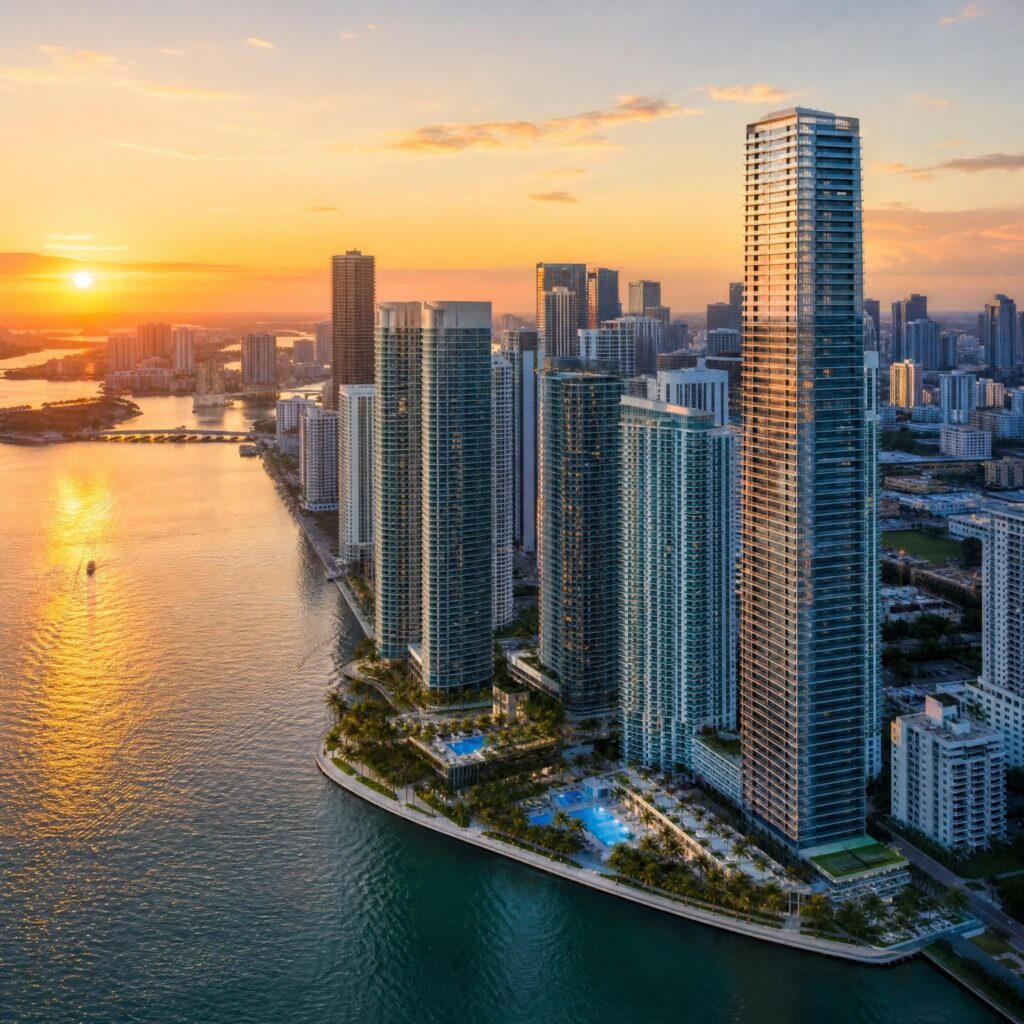
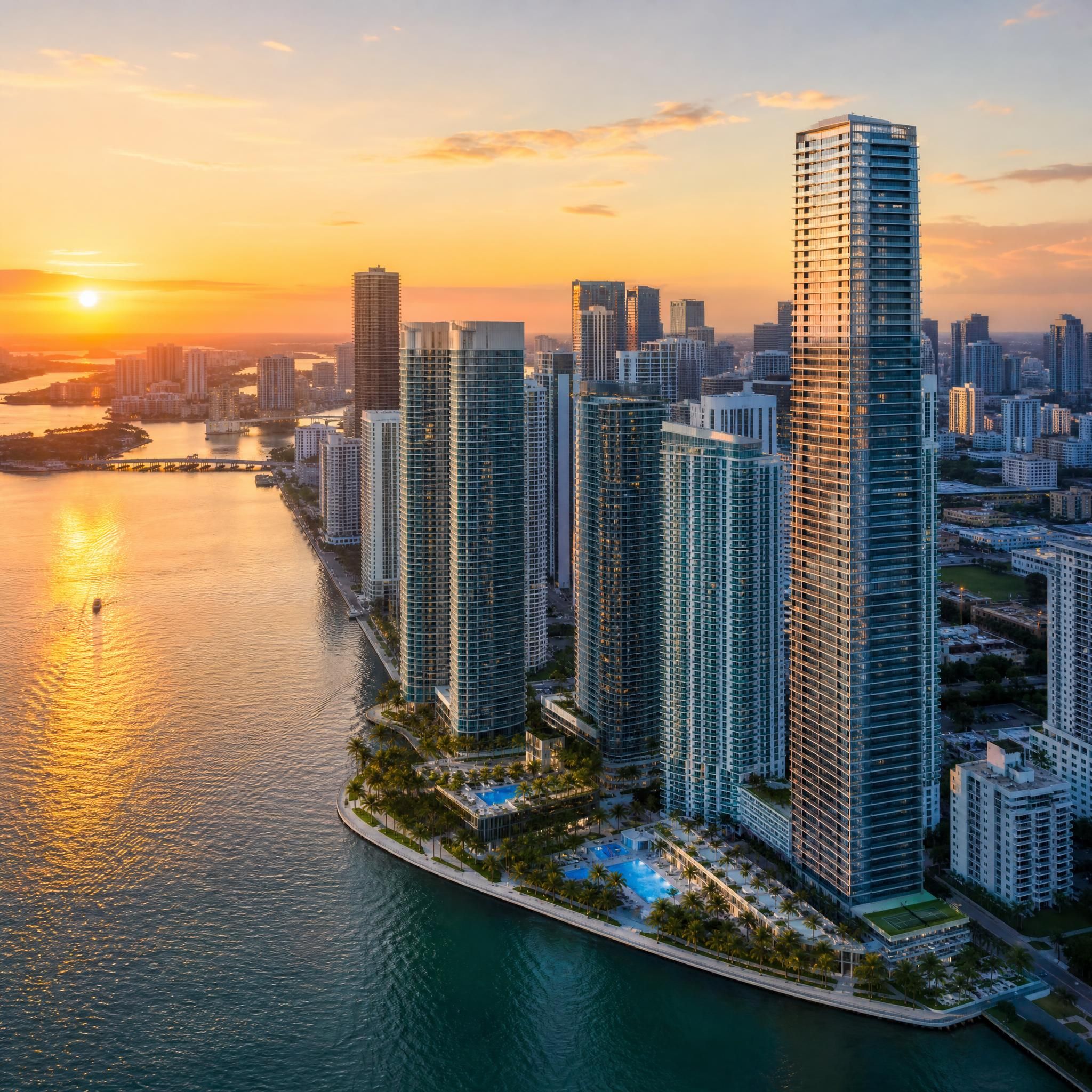
Buying a new construction luxury home in Miami is not like buying a resale property. The timelines are longer, the contracts are developer-drafted, the deposits are larger, and the rewards — when you get it right — can be extraordinary. In 2026, with Miami's luxury real estate market recording its third-strongest first quarter ever and international buyers pouring capital into South Florida from over 73 countries, the opportunity is real. But so are the pitfalls.
This guide cuts through the marketing gloss and gives you the actionable, step-by-step strategies you need to navigate Miami's new construction luxury market with confidence — from choosing the right neighborhood and vetting developers, to structuring deposits, decoding HOA fees, and closing on your dream property.
Table of contents
- Why New Construction? The Strategic Case
- Step 1: Define Your Goals Before You Tour a Single Building
- Step 2: Choose the Right Neighborhood
- Step 3: Vet the Developer — The Most Critical Step
- Step 4: Understand Deposit Structures and Cash Flow Planning
- Step 5: Decode HOA Fees and Hidden Costs
- Step 6: Hire an Independent Agent and Attorney
- Step 7: Negotiate Smartly and Lock In Your Unit
- Step 8: Navigate to Closing
- Key Statistics
- FAQ
Why new construction? the strategic case
Buying pre-construction in Miami means purchasing a condo from the developer before it is built, locking in current pricing while the building is under construction. The process typically takes 2–4 years from reservation to move-in, requires deposits of 20–50% during construction, and has historically delivered 20–30% appreciation by the time the building is completed.
Beyond appreciation, new construction delivers something resale simply cannot: a blank canvas. Options range from move-in-ready, recently constructed homes to fully customizable new builds, with new developments including luxury amenities and appealing lifestyle perks.
The macro picture reinforces the case. Miami's luxury condo market experienced one of its strongest first quarters on record in 2026, with a sales increase of 15.2% year-over-year. Predictable mortgage rates and lower HOA fees were the driving factors behind restoring buyer confidence, while a weaker U.S. dollar motivated international buyers and helped accelerate momentum.
"Miami luxury condo market Q1 2026 recorded its third-strongest first quarter ever, with sales increasing 15.2% year-over-year"
— CondoBlackBook
Step 1: define your goals before you tour a single building
The single most expensive mistake luxury buyers make is falling in love with a building before clarifying what they actually need. Before you walk into a single sales gallery, answer these three questions honestly:
Are you buying a primary residence, a vacation home, or a pure investment? Your answer determines the neighborhood, price point, and building type. Investors prioritize rental yield and appreciation. End users prioritize location, lifestyle, and finishes.
What is your liquidity position over the next 3–5 years? Pre-construction deposits are staged and illiquid. If you have a major capital event — a business sale, a portfolio rebalancing, a property closing — align your deposit schedule to it.
What is your exit strategy? Are you planning to hold long-term, assign the contract before closing, or rent the unit after delivery? Each path has different implications for the building you choose, the floor plan you select, and the contract clauses you need to negotiate.
Clarity on these three questions will save you months of misdirected research and, potentially, millions of dollars.
Step 2: choose the right neighborhood
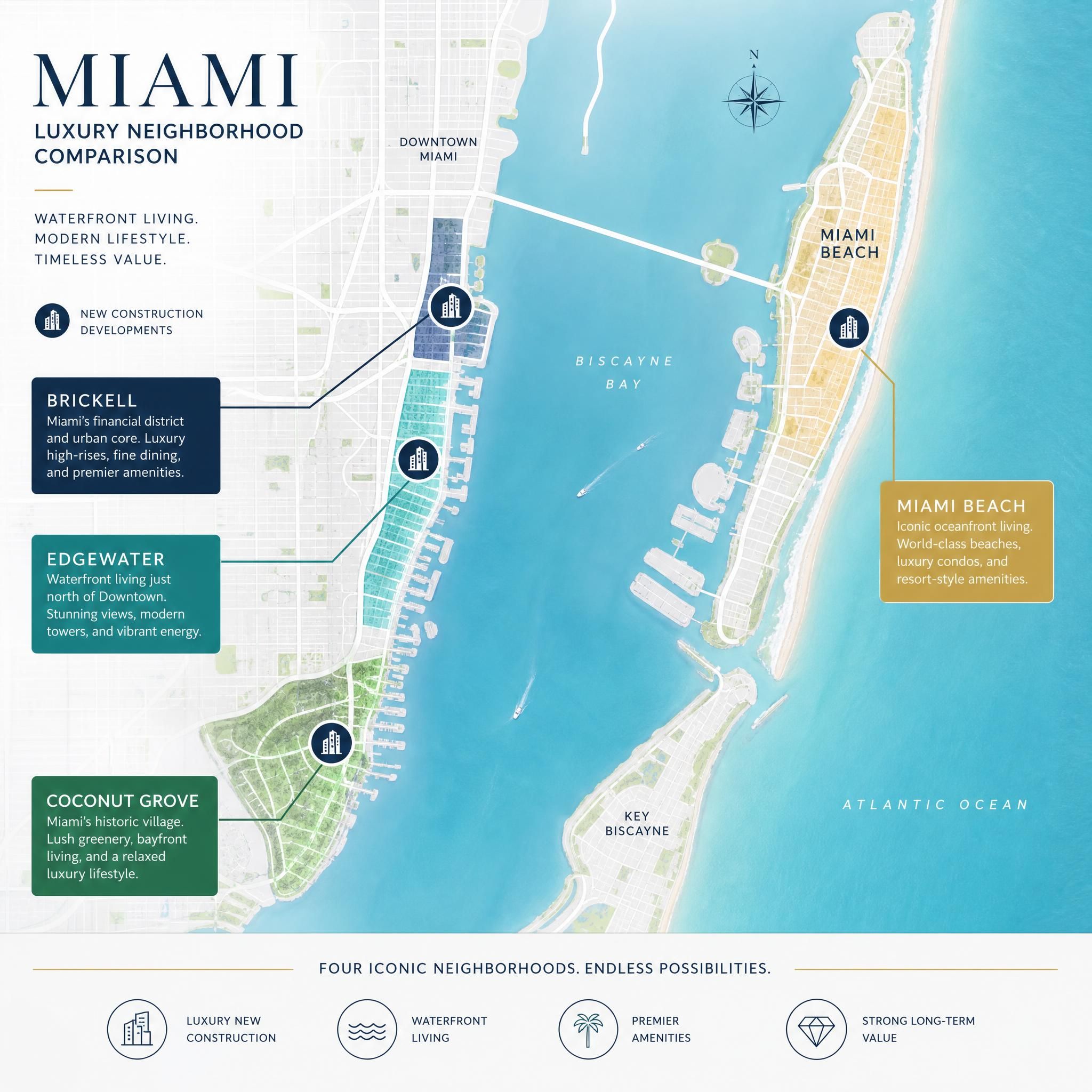
Miami is not one market — it is a collection of distinct micro-markets, each with its own price trajectory, buyer profile, and lifestyle proposition. Here is what the data says in 2026:
Brickell: urban sophistication and branded prestige
Brickell commands the highest premiums for new construction, driven by branded residence projects from St. Regis, Cipriani, and Baccarat that are redefining luxury expectations in the neighborhood. A 74-story tower at 619 Brickell Ave is set to deliver 300 luxury condos, while a $650M Belgian-developer-backed luxury condo tower is under development — signaling the depth of institutional confidence in the submarket. If urban walkability, financial district proximity, and brand cachet are your priorities, Brickell is your arena.
Edgewater: waterfront value with growth momentum
Edgewater continues to represent the strongest value proposition relative to its waterfront positioning and proximity to the Design District. Edgewater has earned nicknames like "the next Brickell" and "affordable Brickell" as it transforms from an industrial waterfront into a luxury residential corridor. Top pre-construction projects here include Aria Reserve, Villa Miami, and EDITION Residences — all offering Biscayne Bay frontage at a price-per-square-foot below Brickell.
Coconut grove: boutique exclusivity and long-term scarcity
Coconut Grove is arguably the most compelling story in Miami luxury new construction right now. The Four Seasons Private Residences Coconut Grove, soaring 20 stories above the lush tree canopies with unobstructed views overlooking Biscayne Bay, will offer only 70 masterfully curated residences with 5-star services and amenities. The development features a 10,000-square-foot spa that rivals high-end resort facilities, including an ice fountain, cold plunge pool, hydrotherapy circuit, and aromatherapy steam rooms. Scarcity of land and strict zoning make Coconut Grove one of the hardest submarkets to replicate — a powerful long-term appreciation driver.
Miami beach: oceanfront glamour at a premium
Miami Beach led South Florida in condo pricing at approximately $1,292 per square foot in recent quarters, above Brickell and Greater Downtown, with South Beach even higher on a year-over-year basis. The market is active: a Miami Beach mansion recently sold for $27M in an all-cash deal after trading at $16.1M just two years prior — a vivid illustration of the appreciation potential in premium waterfront locations.
| Neighborhood | Avg. New Construction PSF | Key Strength | Best For |
|---|---|---|---|
| Brickell | $1,400–$2,500+ | Branded residences, urban core | Professionals, investors |
| Edgewater | $900–$1,400 | Waterfront value, growth runway | First luxury buyers, investors |
| Coconut Grove | $2,000–$4,000+ | Boutique scarcity, nature, exclusivity | UHNW, lifestyle buyers |
| Miami Beach | $1,292–$3,000+ | Oceanfront, global prestige | International buyers, vacation homes |
| Downtown Miami | $700–$1,200 | Entry point, urban energy | Investors, urban dwellers |
Step 3: vet the developer — the most critical step
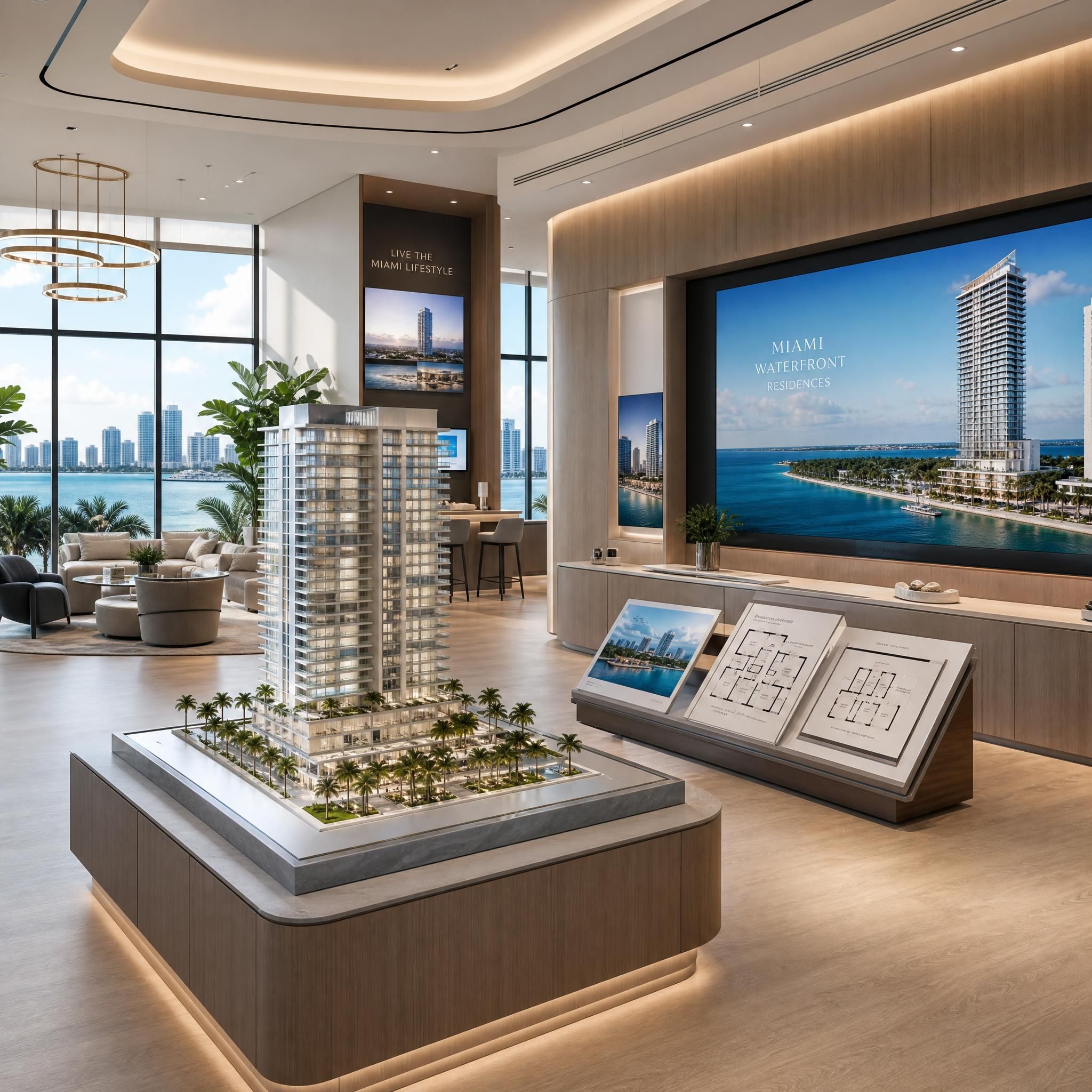
This is where most buyers underinvest their time — and where the most costly mistakes are made. A spectacular unit with a weak developer is a liability. Here is a proven 7-point developer vetting framework:
1. Track Record in Florida: How many projects has this developer completed in Florida specifically? Florida's building codes, humidity, hurricane requirements, and permitting processes are unique. A developer with a strong track record in New York or Dubai is not automatically qualified in Miami.
2. Completed Project Quality: Visit buildings the developer has already delivered. Talk to residents. Look at the common areas two years after opening. Does the build quality hold up? Are there active construction defect lawsuits?
3. Construction Lender Identity: Tier 1 lenders — JPMorgan, Bank of America, Wells Fargo, Santander, Citigroup — signal serious financial vetting. Private equity construction loans are more expensive and sometimes signal the project couldn't secure bank financing. Ask for the pre-sales threshold required to close the construction loan. Most Miami construction lenders require 50% to 70% pre-sales before releasing funding. If a project is at 30% pre-sales and claiming it has financing, verify.
4. Principal Background Check: Research the individual principals, not just the LLC. Search for litigation history, bankruptcy filings, and prior project disputes. Developer entities are often newly formed LLCs — the principals' history is what matters.
5. Escrow Structure: Where are your deposits held? Florida law requires developer deposits to be held in escrow, but the quality of that escrow arrangement varies. Confirm that deposits are held by a reputable title company with full insurance backing.
6. Pre-Sales Velocity: A building at 75%+ sold is de-risked. A building at 30% sold 18 months into its sales cycle carries more uncertainty. Yellow-flag patterns to watch include a project at 40% or less pre-sales 18 months into construction, repeated delay announcements with generic "supply chain" language, and a sales team refusing to disclose the construction lender identity.
7. Brand Partnership Credibility: Branded residences (Four Seasons, St. Regis, Mandarin Oriental) add a layer of accountability. Brands protect their reputation aggressively and typically conduct their own vetting of developer partners — providing an additional quality filter.
"The developer matters more than the building. A mediocre unit at a great developer almost always outperforms a spectacular unit at a mediocre developer over a 5-year hold."
— Luxury Real Estate Advisor, LuxuryDade
Step 4: understand deposit structures and cash flow planning
Pre-construction deposit structures in Miami's luxury segment are substantial and staged. Understanding them is essential before you commit.
Most ultra-luxury towers ask for a total deposit between 40 and 50 percent of the purchase price, spread across reservation, contract signing, groundbreaking, structural milestones such as top-off, and sometimes a later pre-closing installment, with the remaining balance due at closing.
Here is a typical deposit schedule for a Miami ultra-luxury tower:
| Milestone | Typical Deposit % |
|---|---|
| Reservation / LOI | 5–10% |
| Contract Signing | 10–15% |
| Groundbreaking | 5–10% |
| Top-Off / Structural Completion | 5–10% |
| Pre-Closing | 5% |
| Total Pre-Closing | 40–50% |
| Balance at Closing | 50–60% |
For buyers, the staged structure can be used strategically. Instead of wiring 40 or 50 percent of the purchase price on day one, you can align deposits with liquidity events, investment maturities, or the sale of other assets. In a rising market, locking a residence at today's price while the building delivers over the next two to three years can also create a built-in equity uplift by the time you close.
Pro Tip: Start the mortgage approval process 90–120 days before your estimated completion date. Lenders assess the building's financial health, insurance, and HOA reserves as part of condo financing — not just your personal creditworthiness.
Step 5: decode HOA fees and hidden costs

HOA fees in Miami's luxury new construction segment are not trivial — and they are frequently misunderstood. In full-service luxury high-rises, monthly dues can range from $1,500 to $5,000+ per month, depending on the building's amenity load and staffing model.
For luxury high-rises with extensive amenities, full staffing, controlled access, and multiple common spaces, HOA fees tend to be higher — but these buildings best serve buyers who value service, convenience, and building experience.
What smart buyers evaluate before signing:
- Reserve Fund Adequacy: Is the association adequately funded for future capital repairs? Under Florida's HB 913 regulations (effective 2025–2026), buildings must now meet stricter reserve funding requirements. This is actually good news for buyers — it means better-maintained buildings and fewer surprise special assessments.
- Insurance Structure: Luxury towers in South Florida carry substantial building insurance costs. Confirm what the master policy covers versus what you need to insure individually.
- Special Assessment History: Ask the developer or management company whether any special assessments are planned or anticipated in the first five years.
- Rental Restrictions: If you plan to rent your unit, verify the building's minimum lease terms. Some luxury buildings restrict short-term rentals entirely; others allow them with conditions.
Condo dues rarely stay flat forever. In Miami and across coastal Florida, association budgets can change when insurance costs shift, when major systems age, or when the board needs to increase reserves. Model HOA fees as a variable cost in your underwriting — not a fixed one.
Step 6: hire an independent agent and attorney
This step is non-negotiable for any serious luxury buyer.
The most common mistake buyers make is going directly to the developer's sales office without an independent agent. The developer's team will never tell you that a competing project offers better value, a more favorable deposit structure, or a stronger developer track record.
Your buyer's agent costs you nothing — developer commissions are paid by the seller. But an experienced independent agent provides:
- Access to pre-public inventory and VIP pricing tiers
- Honest comparative analysis across competing projects
- Negotiating leverage on unit selection, upgrades, and assignment rights
- Relationships with building management and developer principals
On the legal side: Florida does not require a lawyer at closing, but a real estate attorney is strongly recommended for pre-construction. A real estate attorney reviews the developer purchase agreement, escrow structure, and assignment clauses. Expect $1,500 to $4,000 in legal fees.
The attorney review of the purchase agreement is where deals are won and lost. Key clauses to scrutinize include: the developer's right to make material changes to the building, force majeure provisions, the assignment clause (can you sell your contract before closing?), and the conditions under which you can cancel and receive a full deposit refund.
Step 7: negotiate smartly and lock in your unit
Contrary to popular belief, there is meaningful room to negotiate in Miami's luxury new construction market — if you know where to push.
What is negotiable:
- Unit selection and floor: Higher floors and preferred exposure units carry premiums. Early buyers in the sales process often have the best selection at the lowest prices.
- Upgrade packages: Developers often offer upgrade credits or complimentary finishes (kitchen packages, flooring upgrades, smart home systems) to early buyers or bulk purchases.
- Assignment rights: The ability to sell your contract before closing is enormously valuable. Push for broad assignment rights with minimal restrictions.
- Parking and storage: In luxury towers, additional parking spaces and storage units are premium assets that can be negotiated into the purchase.
- Closing cost contributions: In a buyer's market — which Miami's luxury segment partially is in 2026 — developers may offer closing cost contributions or HOA fee credits for the first year.
What is typically non-negotiable:
- Base purchase price (especially in high-demand projects above 60% sold)
- Deposit schedule structure
- Standard building finishes and floor plans
Step 8: navigate to closing
The final stretch requires active management. Do not go dark after signing your contract.
Stay Informed on Construction Progress: Visit the site periodically. Request quarterly construction updates from the developer. Know your milestone dates — they trigger your deposit installments.
Conduct a Pre-Closing Walk-Through: Before you close, walk through the unit with a licensed inspector. Document every defect, unfinished item, and deviation from the purchase agreement specifications. Developers will typically warranty their work for the building and unit for a reasonable period, and are typically more gracious if they are still doing lots of closings and still have repair crews and open master permits on-site.
Secure Financing Early: If you are financing any portion of the purchase, begin lender conversations at least 90–120 days before the anticipated Certificate of Occupancy. Condo financing has additional complexity — lenders evaluate the building's financial health, owner-occupancy ratios, and insurance as part of the approval process.
Understand FIRPTA for International Buyers: Foreign buyers should work with a cross-border tax attorney to understand FIRPTA withholding obligations and optimal ownership structures (personal, LLC, trust) before closing.
Review the Final Closing Statement Carefully: Closing costs in Florida typically include documentary stamp taxes, title insurance, recording fees, and prorated HOA dues. Budget 2–3% of the purchase price for closing costs beyond your deposit balance.
Chiffres clés
📊 +15.2% year-over-year sales increase — third-strongest Q1 on record – Miami Luxury Condo Market Q1 2026
📊 15.2% — Year-over-year sales increase in Miami's luxury condo market in Q1 2026, marking the third-strongest first quarter ever recorded (Source: CondoBlackBook)
📊 49–52% of all new construction sales – International Buyers in South Florida New Construction
🌎 49–52% of all new construction and pre-construction sales in South Florida were purchased by international buyers over the past 18 months (Source: MIAMI Realtors / Million Luxury)
📊 20–30% average appreciation from reservation to delivery – Pre-Construction Appreciation
💡 20–30% — Historical average appreciation delivered by Miami pre-construction condos from reservation to building completion (Source: LuxuryDade)
📊 $3.2 billion – Foreign Buyer Sales Volume Miami-Dade 2025
💰 $3.2 billion — Foreign-buyer sales volume in Miami-Dade County in 2025 alone, led by Colombian buyers, confirming Miami's position as the #1 U.S. market for international home buyers (Source: CondoBlackBook)
Questions fréquentes (FAQ)
How long does the pre-construction buying process take in miami?
The pre-construction buying process in Miami typically takes 2–4 years from reservation to move-in, as deposits are staged during construction and the remaining balance is due at closing when the building receives its Certificate of Occupancy. The timeline varies by project size and construction complexity — boutique towers of under 100 units often deliver faster than large-scale developments with 300+ residences.
What deposit percentage should i expect for a luxury miami pre-construction condo?
Most ultra-luxury towers ask for a total deposit between 40 and 50 percent of the purchase price, spread across reservation, contract signing, groundbreaking, structural milestones, and sometimes a later pre-closing installment, with the remaining balance due at closing. Some mid-market luxury projects offer lower deposit structures of 20–30% to attract a broader buyer pool.
Do i need a real estate attorney to buy a new construction condo in miami?
While Florida does not legally require an attorney at closing, it is strongly advisable for pre-construction purchases. A real estate attorney reviews the developer purchase agreement, escrow structure, and assignment clauses. According to the Florida Bar 2025 real estate survey, 78 percent of pre-construction buyers use attorneys, and legal fees typically range from $1,500 to $4,000.
Which miami neighborhood offers the best value for luxury new construction in 2026?
Edgewater continues to represent the strongest value proposition relative to its waterfront positioning and proximity to the Design District, making it the go-to neighborhood for buyers seeking Biscayne Bay frontage at a lower price-per-square-foot than Brickell or Miami Beach. For long-term appreciation driven by scarcity, Coconut Grove's boutique developments — with strict zoning limiting future supply — present a compelling case.
Can international buyers purchase new construction luxury condos in miami?
Yes, and they do so at scale. Global buyers accounted for 52% of South Florida new-construction, pre-construction, and condo-conversion sales over a 22-month period, with buyers from 73 countries. International buyers should work with a cross-border tax attorney to optimize ownership structure (personal name, LLC, or trust) and understand FIRPTA withholding obligations before closing.
Ready to take your next step? Schedule a private consultation with our Miami luxury real estate specialists to access curated new construction opportunities, off-market inventory, and developer relationships that give you a genuine edge in this market.


