
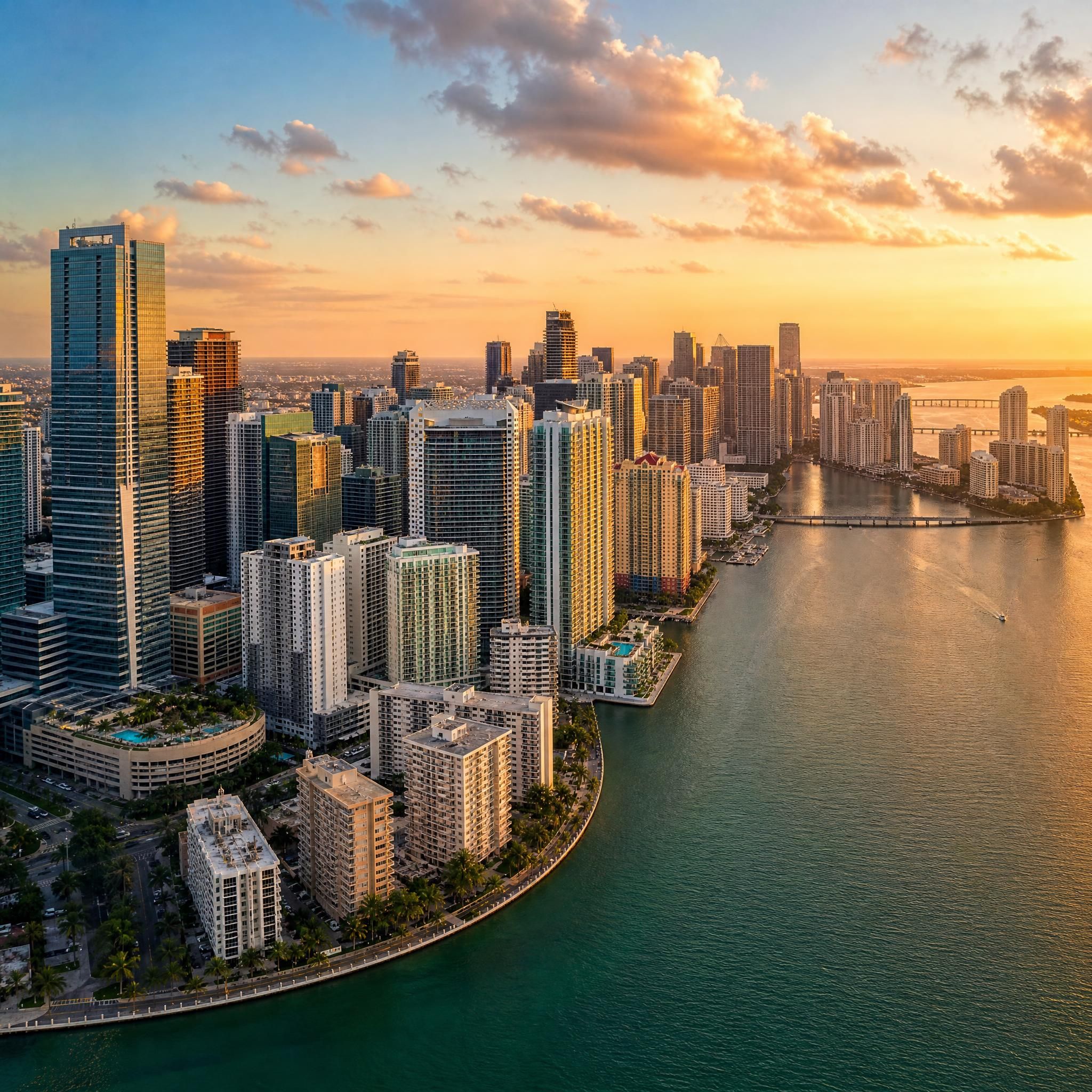
Miami's luxury real estate market doesn't reward hesitation — it rewards preparation. Whether you're eyeing a glass-wrapped penthouse in Brickell, a bayfront residence in Edgewater, or a branded condo in Coconut Grove, the difference between a smart acquisition and a costly mistake often comes down to one thing: knowing exactly how to play the game before you walk into the sales gallery.
In 2026, the stakes have never been higher — or the opportunities more compelling. Miami has overtaken New York as the major U.S. city with the most $1 million homes, as wealthy buyers continue heading south. In the 22 months leading up to November 2025, international investors accounted for 52% of new construction sales in the Miami market area — a figure that signals just how globally competitive this market has become.
This guide cuts through the noise. Below are seven battle-tested, actionable strategies to help you navigate Miami's new construction luxury condo market in 2026 — from identifying the right neighborhood to closing with confidence.
Table of contents
- Strategy 1: Choose Your Neighborhood Based on Data, Not Hype
- Strategy 2: Vet the Developer Before You Fall in Love with the Renderings
- Strategy 3: Master the Pre-Construction Deposit Structure
- Strategy 4: Conduct Airtight Due Diligence on the Condo Docs
- Strategy 5: Negotiate Like an Insider
- Strategy 6: Line Up Your Financing Early — Very Early
- Strategy 7: Think Exit Before You Enter
- Key Statistics
- FAQ
Strategy 1: choose your neighborhood based on data, not hype
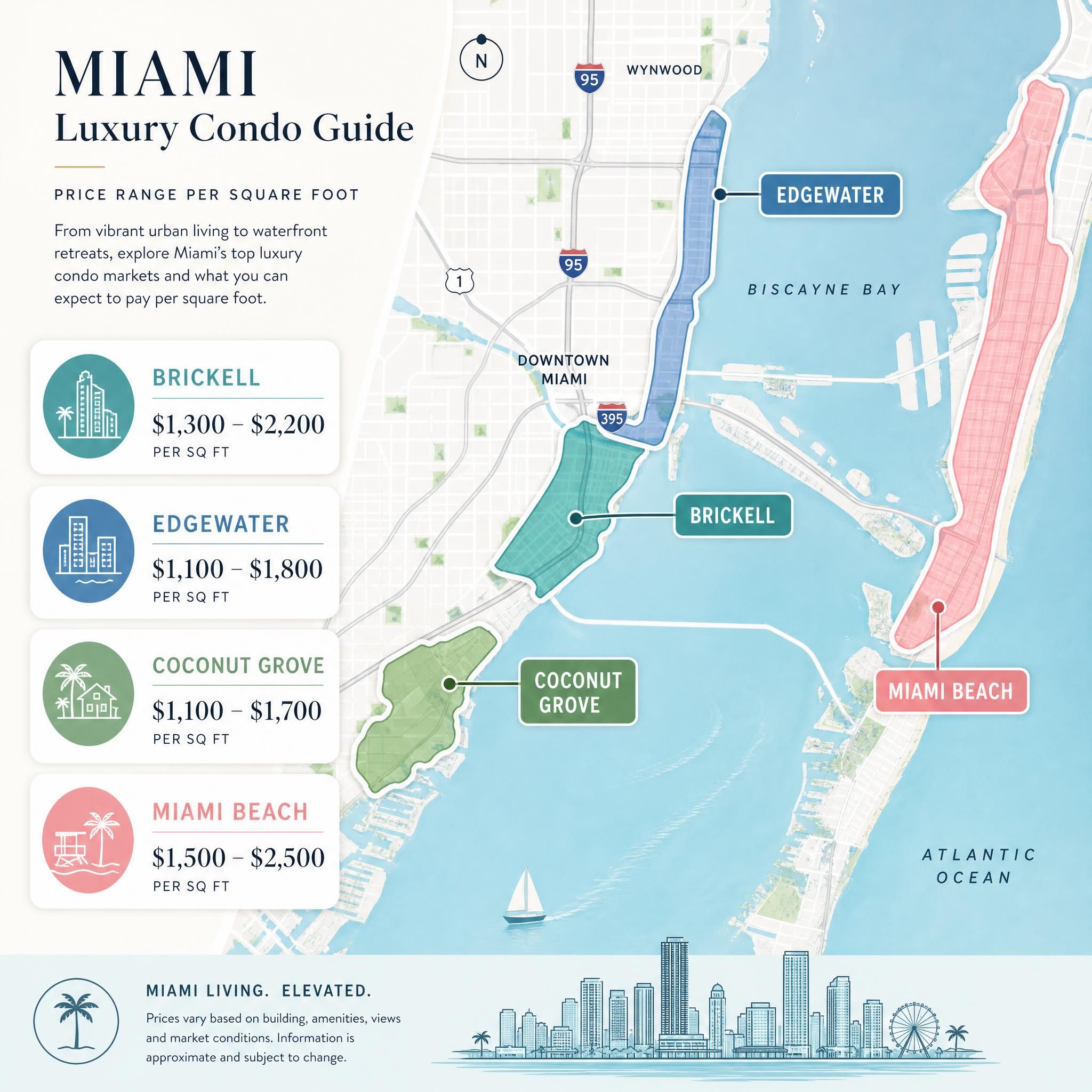
Miami's luxury condo market is not a monolith. Miami real estate divides into three major submarkets: Greater Downtown (Brickell, Downtown, Edgewater, Wynwood), Miami Beaches (South Beach, Mid-Beach, North Beach, Surfside, Bal Harbour, Sunny Isles, Fisher Island), and The Gables & Grove (Coral Gables and Coconut Grove). Each submarket has its own rhythm, buyer profile, and investment characteristics.
Here's how the top neighborhoods stack up for new construction luxury buyers in 2026:
| Neighborhood | Price Range (per sq ft) | Best For | Market Pace |
|---|---|---|---|
| Brickell | $700–$950 | Urban professionals, investors | Strong demand |
| Edgewater | $950–$1,000 | Bayfront living, appreciation | Fast-growing |
| Coconut Grove | Premium boutique | Families, low inventory | Fastest-selling |
| South Beach | Ultra-luxury tier | Lifestyle, price appreciation | High competition |
| Wynwood | Entry luxury | Short-term rental investors | Emerging |
| Sunny Isles | $1,200–$2,000+ | Branded residences, international | Strong foreign demand |
New construction is concentrated in Edgewater, Brickell, and Sunny Isles, with branded residences driving the ultra-luxury segment.
The actionable tip: Coconut Grove and Coral Gables sell fastest — averaging 56 days on market — and carry the lowest inventory levels compared to the broader Downtown and Miami Beach submarkets. If you're looking for scarcity-driven appreciation, the Grove is your strongest play. For new construction supply and flexibility, Edgewater and Brickell offer the widest selection right now.
Strategy 2: vet the developer before you fall in love with the renderings
The most beautiful sales gallery in Miami cannot substitute for developer due diligence. In a market where branded residences — Bentley, Aston Martin, Four Seasons, Mandarin Oriental — are launching simultaneously, it's easy to get swept up in the lifestyle narrative. Don't.
Rankings of the best new construction condos in Miami should be based on hard data: price per sq ft vs. resale comps, developer track record, location fundamentals, HOA exposure, and long-term appreciation.
Your developer vetting checklist:
- ✅ Track record: Has this developer delivered on time in previous Miami projects? Review completed buildings and their current resale values.
- ✅ Financial backing: Is the construction fully financed? JLL secured over $565M in construction financing for an ultra-luxury condominium tower in Miami — the scale of institutional backing matters.
- ✅ Litigation history: Always ask whether the association or developer is involved in any active lawsuits. Residents at the Aston Martin luxury Miami condo tower have claimed construction defects — a cautionary tale for buyers who skip this step.
- ✅ Delivery timeline language: Vague delivery timelines in a contract are a red flag. Pin down specific dates and understand the consequences of delays.
- ✅ Unit count and scarcity: Fewer units in a building typically means stronger appreciation. A boutique tower of 60 residences behaves very differently from a 500-unit high-rise.
Pro tip: Ask your agent to pull the resale performance data from the developer's last three completed Miami projects. If values at delivery matched or exceeded pre-construction prices, that's a green light.
Strategy 3: master the pre-construction deposit structure
This is where many luxury buyers — even experienced ones — get caught off guard. Miami pre-construction is not a simple down payment and mortgage. It's a multi-stage financial commitment that unfolds over years.
In most luxury developments, buyers commit between 30 and 50 percent of the purchase price before delivery. For illustration, a developer might structure deposits on a $5 million residence as 20% at contract, 10% at groundbreaking, 10% twelve months later, and 60% at closing — mirroring the approach seen in several flagship launches on Biscayne Bay.
What this means in practice:
| Deposit Stage | Typical % | Timing |
|---|---|---|
| Reservation / Contract signing | 10–20% | Immediately |
| Groundbreaking | 10% | 6–12 months post-contract |
| Construction milestone | 10% | 12–18 months post-contract |
| Closing (cash or mortgage) | 60–70% | Upon completion |
Your action steps:
- Audit your liquidity before signing anything. Confirm you can comfortably cover staged deposits without liquidating core assets.
- Negotiate deposit protections. Ensure your contract specifies that deposits are held in escrow — not released to the developer during construction.
- Understand your cancellation rights. If you need to cancel, a lawyer will look at condo docs for amendments, construction timelines, and any material defects or differences between what was promised and what was delivered.
Strategy 4: conduct airtight due diligence on the condo docs
Skipping or rushing through condo document review is the single most expensive mistake luxury buyers make in Miami. These documents govern your life in the building — and your ability to resell or rent it.
For new construction, the developer provides a prospectus. In Florida, sellers of resale condos are required to provide buyers with a set of governing documents, including the Declaration of Condominium, the Articles of Incorporation, the Association Bylaws, the Rules and Regulations, the most recent year-end financial statements, the current operating budget, and the meeting minutes from the last 12 months.
The critical documents to review with your attorney:
- Declaration of Condominium — defines your unit boundaries, common areas, and usage rights
- Operating Budget & Reserve Study — underfunded reserves are a special assessment waiting to happen
- Rules & Regulations — rental restrictions, pet policies, renovation rules
- Developer Control Period — how long the developer retains control of the HOA board
- Active Litigation — any ongoing lawsuits against the association or developer
Buyers of units in newer towers completed after 2010 in Edgewater, Brickell City Centre, or the Coconut Grove waterfront face far fewer structural concerns — but even newer buildings can have construction defect claims or ongoing litigation that affects the property's insurability and resale value.
HOA fee reality check: Luxury buildings in Miami carry HOA fees that often range from $1,500 to $5,000+ per month depending on the amenity package. Factor this into your total cost of ownership — not just the purchase price.
Strategy 5: negotiate like an insider
Here's the truth most sales galleries won't tell you: Miami's luxury condo market ($1M+) is currently a buyer's market with 20 months of inventory, and buyers have negotiating power, with most properties selling 5–7% below asking.
In pre-construction, the leverage window is specific — and temporary. Developers are most motivated to negotiate in the early phases of sales, before a project hits 50–60% sold. Once a building crosses 70–80% sold, incentives disappear and prices often increase.
What you can negotiate in a Miami pre-construction purchase:
| Negotiable Item | How to Approach It |
|---|---|
| Purchase price | Most effective in early sales phases or for bulk/multiple units |
| Upgrade packages | Request premium finishes at base price |
| Parking spaces | Extra spots or premium locations |
| Storage units | Often overlooked but valuable |
| Closing cost contributions | Developer may cover title insurance or transfer fees |
| Assignment rights | Negotiate the right to sell your contract before delivery |
| Rental restrictions | Negotiate short-term rental permissions upfront |
Insider move: Always bring an experienced buyer's agent to the sales gallery. Developer sales teams represent the developer's interests — not yours. A skilled buyer's agent knows the project's sales velocity, can identify motivated-seller signals, and negotiates on your behalf at no cost to you (the developer pays the commission).
Strategy 6: line up your financing early — very early
Pre-construction financing in Miami operates on a completely different timeline than a standard mortgage. Most buyers make the mistake of waiting until the building is near completion to think about their loan — by then, it's often too late to avoid delays or complications at closing.
As a rule of thumb, buyers of pre-construction condos in Miami are required to pay about 30% to 50% of the purchase price before closing, with the balance due at closing.
Your financing options as a luxury buyer:
- Jumbo Loans — Most commonly used for luxury condominium purchases in Miami
- Super Jumbo Financing — Available for high-end residences above $3M+
- Foreign National Programs — Specifically designed for international buyers; typically require 30–40% down
- DSCR Loans — Popular among investors purchasing for rental income
- All-Cash — Preferred by many sellers and developers; often unlocks better pricing
Critical timing actions:
- Get pre-qualified 12–18 months before anticipated closing — lenders evaluate both you and the condo project
- Confirm project eligibility early — lenders assess owner-occupancy ratios, reserve funding, and rental policies
- Lock in your rate strategically — work with a lender experienced in Miami luxury pre-construction who understands the unique timing windows
Many pre-construction contracts are not contingent on financing. If you need a loan, seek explicit contingency language, or be sure you can perform if financing changes. Appraisals for new buildings rely on limited comps, so loan proceeds can be conservative.
Strategy 7: think exit before you enter
The most sophisticated luxury buyers in Miami don't just ask "Do I love this unit?" — they ask "Who will want to buy or rent this unit in five to ten years, and why?"
Miami has had 14 consecutive years of price appreciation for Miami-Dade condominiums, but not every building participates equally in that trend. Appreciation is driven by scarcity, location, brand cachet, and the quality of the buyer pool attracted to the building.
The appreciation framework — evaluate every purchase through these three lenses:
- Supply constraint — How many units are in this building? How many comparable units exist in the submarket? The harder a product is to replicate, the stronger its appreciation potential.
- Neighborhood trajectory — Where is the neighborhood heading? Edgewater is easily one of Miami's rapidly up-and-coming luxury waterfront neighborhoods — from a low-key area barely noticed 15 years ago to a hotbed for new luxury construction bayfront condos. Early positioning in an ascending neighborhood amplifies returns.
- Rental income potential — Short-term rentals are generally allowed in Edgewater, although policies vary from building to building. Wynwood is notably short-term rental approved. Confirm rental policies before purchasing if income generation is part of your strategy.
Resale positioning checklist:
- ✅ Corner unit or high-floor position with unobstructed views
- ✅ Branded residence with global name recognition (Four Seasons, Mandarin Oriental, Bentley)
- ✅ Low unit count building (boutique = scarcity = premium resale)
- ✅ No active litigation at time of purchase
- ✅ Financially healthy HOA with fully funded reserves
Chiffres clés
📊 424 luxury condo sales closed in Miami in Q1 2026 — a +15.2% year-over-year increase, with a median sale price of $1.84M (Source: CondoBlackbook Q1 2026 Miami Luxury Condo Market Summary)
📊 $1.84M (+2.3% YoY) – Miami Luxury Condo Median Sale Price Q1 2026
💡 52% of new construction homes in Miami were purchased by foreign buyers in the 22 months leading up to November 2025 (Source: MIAMI Association of REALTORS®)
📊 52% – Foreign Buyer Share of Miami New Construction
🏙️ $3.2 billion in foreign-buyer sales volume was recorded in Miami-Dade County in 2025 alone, led by Colombian buyers (Source: CondoBlackbook)
📊 $3.2 Billion – Foreign Buyer Sales Volume Miami-Dade 2025
🔑 14 consecutive years of price appreciation for Miami-Dade condominiums (Source: MIAMI Association of REALTORS®)
📊 14 Consecutive Years – Miami-Dade Condo Price Appreciation Streak
Faq
How much deposit do i need for a new construction luxury condo in miami?
Most luxury pre-construction developments in Miami require between 30% and 50% of the total purchase price before closing, paid in staged installments. A typical structure might be 20% at contract signing, 10% at groundbreaking, 10% at a construction milestone, and the remaining 60–70% at closing — either in cash or via a mortgage. Always confirm the exact schedule in your purchase contract and ensure deposits are held in a protected escrow account.
Is now a good time to buy a new construction luxury condo in miami in 2026?
Yes — but strategically. Miami's luxury condo market ($1M+) is currently in buyer's market territory with approximately 20 months of inventory, meaning buyers have meaningful negotiating leverage. Prices have shown moderate appreciation (+2.3% year-over-year in Q1 2026), and the combination of a weaker U.S. dollar, continued foreign demand, and a strong pipeline of branded residences makes 2026 a compelling entry window — particularly for early-phase pre-construction purchases before buildings hit 70–80% sold.
What are the biggest red flags to watch for in a miami pre-construction contract?
The most common red flags include: vague or open-ended delivery timelines with no penalty clauses, deposit funds that are not held in escrow, broad "pass-through cost" clauses that allow the developer to increase your costs, unclear assignment rights (preventing you from selling before delivery), and absence of a financing contingency if you plan to use a mortgage. Always have a Florida real estate attorney review the full contract before signing.
Can international buyers purchase new construction luxury condos in miami?
Absolutely — and they do so in large numbers. Miami is the #1 U.S. market for foreign home buyers, with specialized Foreign National loan programs available that typically require 30–40% down. International buyers benefit from the same property rights as U.S. citizens, and many luxury developments have sales teams that speak multiple languages and are specifically experienced with cross-border transactions. Consult with a Miami-based real estate attorney familiar with FIRPTA (Foreign Investment in Real Property Tax Act) implications before closing.
How do i evaluate whether a miami luxury condo is a good investment?
Evaluate through three lenses: (1) Supply constraint — fewer units in the building and limited comparable inventory in the submarket drives appreciation; (2) Neighborhood trajectory — is the area actively improving in infrastructure, dining, and buyer profile?; (3) Rental income potential — confirm the building's short-term and long-term rental policies align with your income strategy. Layer in the developer's track record, HOA financial health, and the building's resale history (for completed projects) to complete your analysis.
Conclusion: your miami advantage starts with the right strategy
Miami's new construction luxury market in 2026 is simultaneously one of the most exciting — and most complex — real estate environments in the world. The buyers who win here aren't necessarily the ones with the deepest pockets. They're the ones who do their homework, build the right team, and execute with discipline.
Follow the seven strategies in this guide: choose your neighborhood with data, vet your developer rigorously, understand the deposit structure, conduct thorough due diligence, negotiate from a position of knowledge, secure financing early, and always think about your exit before you sign.
The opportunity is real. Miami's Q1 2026 luxury condo closed sales accelerated +25.4% quarter-over-quarter, signaling that the window of buyer-market leverage won't stay open indefinitely. The best units in the best buildings are already moving.
Ready to take the next step? Schedule a private consultation with a Miami luxury real estate specialist to review current new construction opportunities tailored to your goals, timeline, and investment strategy. Your elevated Miami life is closer than you think — it just starts with the right move.
"Miami luxury condo closed sales reached 424 in Q1 2026, a +15.2% year-over-year increase with a median sale price of $1.84M"
— CondoBlackbook Q1 2026 Miami Luxury Condo Market Summary
"Foreign buyers accounted for 52% of new construction sales in Miami over 22 months"
— MIAMI Association of REALTORS®


