
Selling a property in South Florida in 2026 is not the same game it was two years ago. Buyers are more informed, inventory has shifted, and the difference between a home that sells quickly at full price and one that languishes on the market for months often comes down to a handful of strategic decisions made before the listing goes live.
The good news? The fundamentals in Miami-Dade and Broward County remain strong. Broward's $1M+ home sales climbed nearly 20% year-over-year in early 2026, cash transactions account for over 41% of closed sales, and wealth migration from high-tax states like New York and California continues to fuel demand. But in a market where buyers are increasingly selective and value-driven, sellers who execute with precision win — and those who don't leave serious money on the table.
Here are seven actionable strategies to sell your property faster and for the highest possible price in Miami-Dade and Broward County in 2026.
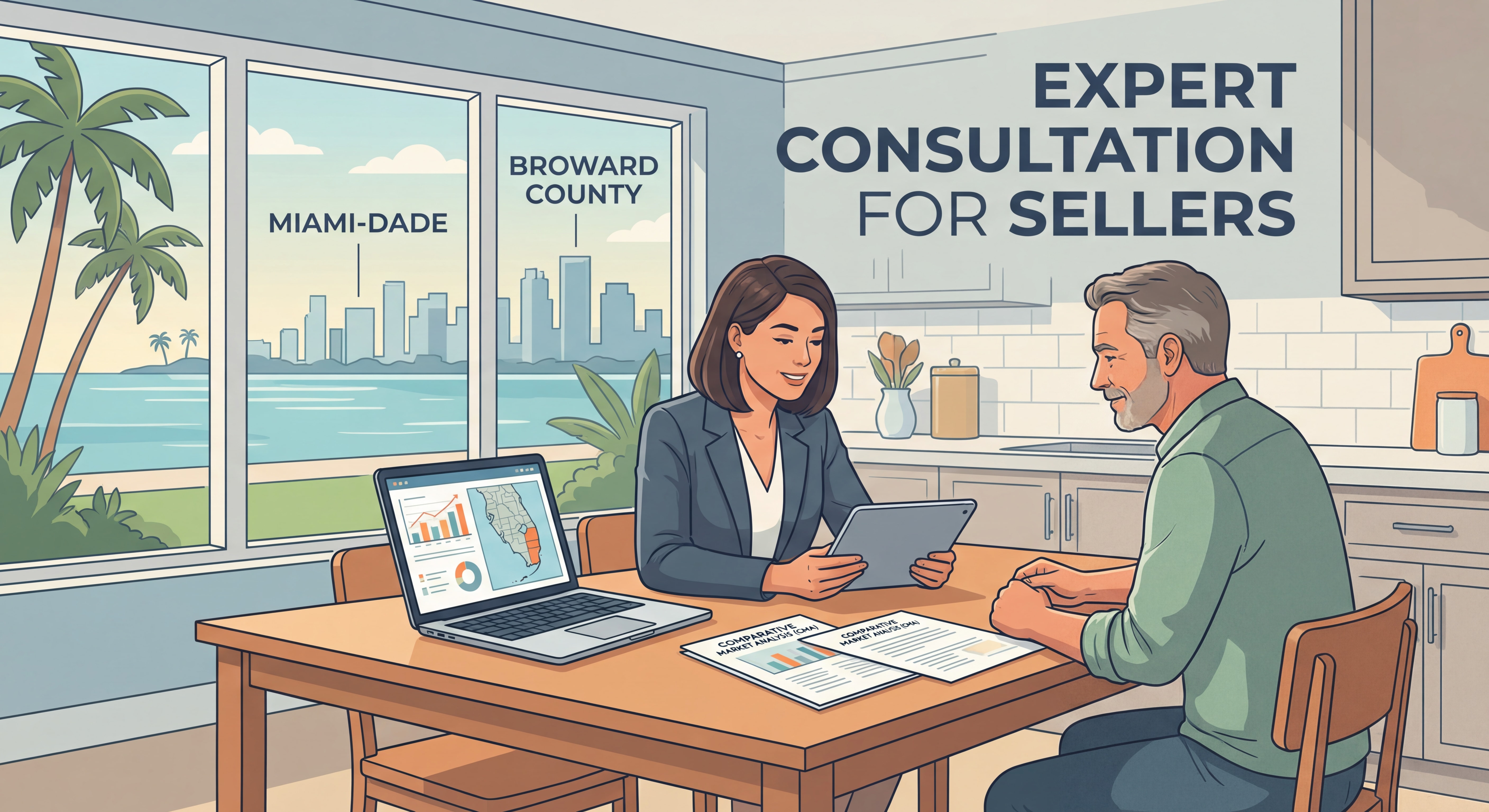
Ready to sell? Schedule your free consultation today and get a professional market analysis for your Miami-Dade or Broward property.
Table of Contents
- 1. Price with Data, Not Emotion
- 2. Master the Insurance-Adjusted Value
- 3. Stage for the South Florida Buyer
- 4. Invest in Professional Photography and Digital Marketing
- 5. Time Your Listing Strategically
- 6. Negotiate Like a Pro
- 7. Know Your Neighborhood's Unique Selling Points
- Common Seller Mistakes to Avoid
- Special Situations: Inherited, Distressed, and Investor Properties
- FAQ
- Key Statistics
1. Price with Data, Not Emotion
Nothing derails a home sale faster than an asking price that doesn't reflect current market realities. In 2026, Miami's inventory has increased, giving buyers more options and more negotiating leverage. Homes priced correctly are selling quickly and close to asking price — homes priced aspirationally are sitting.
How to use a Comparative Market Analysis (CMA) effectively:
- Request a CMA from your listing agent that includes sold comps from the last 90 days, not 6–12 months ago
- Compare properties with similar square footage, bedroom/bath count, lot size, and condition — not just zip code
- Factor in active competing listings, not just past sales — buyers are comparing your home to everything else on the market right now
- Adjust for upgrades: impact windows, new roof (post-2022), updated kitchen, and outdoor entertainment spaces all command premiums in South Florida
The search bracket strategy: Most buyers filter searches by price range on mobile apps. If your home is worth approximately $1.25M, listing at $1,249,000 captures every buyer searching up to $1.25M — and often triggers multiple-offer scenarios that push the final price above valuation.
📊 ~$625,000 (February 2026) – Broward County Median Home Price
Avoid these pricing mistakes:
- Relying on automated estimates (Zestimates) instead of a local CMA
- Pricing based on what you need to net, not what the market will bear
- Ignoring the impact of HOA fees and insurance costs on buyer affordability calculations
2. Master the Insurance-Adjusted Value
This is the most underutilized pricing strategy in South Florida in 2026 — and it can make or break your sale.
Florida's home insurance premiums remain a primary concern for buyers. A property with a post-2022 roof, full impact windows, and a current wind mitigation report can offer buyers dramatically lower annual insurance costs — sometimes $5,000–$15,000 less per year than an older, unfortified home. That directly increases buyer purchasing power and justifies a higher asking price for your property.
Before you list, document and market:
- Roof installation date and permit records
- Impact window/door certifications
- Flood zone designation and elevation certificate
- Wind mitigation inspection report
- Any insurance discounts currently in effect
Presenting these documents proactively — in your listing description, in the MLS, and in your showing packet — removes buyer hesitation and positions your home as a lower total cost of ownership compared to competing properties.
"In 2026, the cost of home insurance is a primary driver of buyer behavior in Florida. A home's price is no longer just about its aesthetic beauty; it's about its fortification."
— Listings with Kris
3. Stage for the South Florida Buyer
In Miami-Dade and Broward, buyers aren't just purchasing square footage — they're buying a lifestyle. Whether your buyer is a relocating executive from Manhattan, a luxury investor from São Paulo, or a local family upgrading in Pembroke Pines, staging your home to speak to that lifestyle is a non-negotiable step.
Miami-Dade and Broward staging essentials:
| Staging Element | Why It Matters in South Florida |
|---|---|
| Natural light maximization | Tropical light is a selling feature — remove heavy drapes, clean windows |
| Outdoor space presentation | Lanais, pools, and patios are major value drivers — stage them |
| Coastal modern aesthetic | Neutral palettes with clean lines appeal to relocation buyers |
| Declutter and depersonalize | Buyers need to visualize their own life in the space |
| Fresh tropical landscaping | Curb appeal in a tropical climate includes lush, manicured greenery |
| Professional deep clean | Non-negotiable before photography and showings |
Cost vs. return: Professional staging in Miami Beach typically runs $800–$3,000 for occupied homes. The ROI is consistently positive — staged homes generate more showings, fewer low offers, and shorter days on market.
For condos in Brickell, Aventura, or Fort Lauderdale: Focus on maximizing the sense of space and highlighting views. Remove excess furniture, use mirrors strategically, and ensure the balcony is immaculate — it's often the first thing buyers walk to.

4. Invest in Professional Photography and Digital Marketing
In 2026, your home's first showing happens online — on a phone screen, often within seconds of a buyer swiping through listings. If your listing photos don't immediately communicate quality and value, buyers move on without ever scheduling a tour.
The non-negotiable marketing checklist for South Florida sellers:
- Professional HDR photography ($200–$500): The baseline. Every listing needs it.
- Aerial/drone footage: Especially critical for waterfront properties, large lots, or homes near Fort Lauderdale Beach, Miami Beach, or Boca Raton
- 3D virtual tour (Matterport): Captures out-of-state and international buyers who can't visit in person — a massive segment of the South Florida buyer pool
- MLS listing with full syndication: Zillow, Realtor.com, Redfin, Trulia, and international portals for foreign buyer reach
- Targeted social media advertising: Facebook and Instagram geo-targeted ads aimed at buyers in New York, New Jersey, California, and Illinois — the top feeder states for Broward County
- Email marketing to agent networks: Your listing agent's buyer agent database can generate early showings before the property even hits the open market
For luxury properties ($1M+): Add a property video walkthrough, lifestyle-focused content (neighborhood amenities, waterfront access, proximity to private schools), and placement on luxury real estate platforms. Realtor.com data confirms South Florida million-dollar home sales surged to an all-time high in early 2026, with nearly a 19% year-over-year increase — this segment demands premium marketing.
📊 +19% (February 2026) – South Florida $1M+ Home Sales YOY Increase
5. Time Your Listing Strategically
When is the best time to sell in South Florida? Unlike northern markets, South Florida doesn't follow a traditional spring peak. Here's the local reality:
- January–April (Peak Season): Snowbirds are in residence, northern buyers are visiting, and demand is highest. This is historically the strongest window to list — more foot traffic, faster sales, and stronger offers.
- May–August: Activity continues, especially from relocation buyers. International buyers remain active. Slightly less competition from other sellers.
- September–November: Market slows slightly, but serious buyers are still active. Price your home competitively to stand out.
- December: Motivated buyers looking to close before year-end. Less inventory means less competition for well-priced homes.
Pro tip from Florida Realtors (March 2026): Establishing a clear listing timeline in advance — including a target listing window and preferred closing range — gives sellers more flexibility and reduces pressure if circumstances shift. Early preparation also allows time for pricing strategy, small updates, and evaluating alternatives such as cash buyers if a faster timeline becomes necessary.
📊 41.1% of all closed sales (February 2026) – Broward Cash Sales Share
6. Negotiate Like a Pro — and Stay Level-Headed
In today's South Florida market, buyers are more assertive than they were during the pandemic frenzy. A lower-than-expected offer is not a rejection — it's the opening of a conversation. Sellers who react emotionally to initial offers often make costly mistakes.
Negotiation strategies that work in 2026:
- Counter strategically, not reactively. If an offer comes in 5–8% below asking, counter at 1–2% below your list price to signal flexibility without giving away value.
- Evaluate the full offer, not just the price. A cash offer with a 21-day close at 3% below asking may be worth more than a financed offer at full price with a 45-day close and inspection contingencies.
- Use inspection results as a negotiating tool. In Florida, sellers are required to disclose known material defects. Getting a pre-listing inspection removes surprises and gives you control over repair narratives.
- Offer seller concessions strategically. In Broward County's condo market, where inventory has increased and days on market are longer, offering to cover closing costs or provide a home warranty can be the difference between a signed contract and a dead deal.
- Understand Florida disclosure requirements. Florida law requires sellers to disclose all known material defects that aren't readily observable. Work with your agent to ensure your disclosure documents are complete — this protects you from post-closing liability.
The biggest negotiation mistake sellers make: Rejecting reasonable offers out of emotional attachment to a price point, then watching the home sit on the market for months and eventually selling for less than the original offer.
7. Know Your Neighborhood's Unique Selling Points
South Florida is not a monolithic market. What sells a home in Coral Gables is different from what sells a home in Hollywood or Kendall. Effective marketing requires speaking directly to the buyer profile most likely to purchase in your specific neighborhood.
| Neighborhood | Key Buyer Profile | Top Selling Points |
|---|---|---|
| Miami Beach / South Beach | International buyers, luxury investors | Oceanfront access, walkability, nightlife, global prestige |
| Coral Gables | Families, professionals, executives | Top-rated schools, Mediterranean architecture, Miracle Mile |
| Aventura | Relocating families, snowbirds | Aventura Mall proximity, waterfront condos, safety |
| Brickell / Downtown Miami | Young professionals, investors | Urban lifestyle, proximity to financial district, new construction |
| Kendall | Families, first-time move-up buyers | Space, affordability relative to Miami, good schools |
| Fort Lauderdale | Boaters, retirees, remote workers | Intracoastal access, walkable beach areas, Brightline connectivity |
| Pembroke Pines / Miramar | Families, South American buyers | Value, newer construction, strong school districts |
| Boca Raton | Affluent retirees, executives | Gated communities, golf, luxury amenities, lower density |
| Hollywood / Hallandale | Investors, snowbirds, value buyers | Beachfront access at lower price points than Miami Beach |
| Coral Springs / Weston | Families, corporate relocators | Top schools, master-planned communities, safety ratings |
Use this insight in your marketing: Your listing description, photography choices, and advertising targeting should all reflect the specific lifestyle your neighborhood offers — not generic South Florida talking points.
Common Seller Mistakes to Avoid
Even experienced sellers make these errors in the 2026 South Florida market:
- Overpricing and then chasing the market down — each price reduction signals weakness and attracts lower offers
- Limiting showing availability — in a competitive market, difficult-to-show homes get skipped in favor of accessible ones
- Neglecting the condo disclosure package — HOA documents, financials, pending special assessments, and estoppel letters must be ready upfront to avoid closing delays
- Choosing an agent based on the highest suggested list price — this is a classic "buying the listing" tactic; choose based on marketing strategy and track record
- Ignoring the condo market's unique challenges — higher HOA fees, new building inspection requirements under Florida's new condo safety laws, and increased inventory mean condo sellers need a sharper strategy in 2026
Special Situations: Inherited, Distressed, and Investor Properties
Inherited property in Miami-Dade or Broward?
Work with a probate attorney and a listing agent simultaneously. Florida's probate process can take 6–12 months, but in many cases, properties can be listed during probate with court approval. Pricing should reflect the property's as-is condition — inherited homes often require updates, and pricing accordingly attracts investors and renovation buyers who can close quickly.
Distressed sale (foreclosure, short sale, divorce)?
Act early. The longer a distressed property sits, the more leverage shifts to buyers. A short sale requires lender approval but can protect your credit compared to foreclosure. An experienced South Florida listing agent who specializes in distressed sales can negotiate with lenders and coordinate the complex timeline involved.
Investor exit (rental property)?
Decide upfront whether to sell occupied or vacant. Vacant properties show better but mean lost rental income during the listing period. Occupied sales require tenant coordination and may limit showing availability. In Broward, where rental demand remains strong, some investors prefer to sell to other investors — market the property's income history prominently.
Let's create a custom selling strategy for your property. Contact us to discuss your goals and timeline — your free consultation is one step away.
Frequently Asked Questions (FAQ)
How long does it take to sell a house in Miami-Dade or Broward County in 2026?
The timeline varies by property type and price point. Single-family homes priced correctly in desirable neighborhoods are selling in 30–60 days. Condos, particularly in buildings with higher HOA fees or pending special assessments, may take longer — 60–90+ days. Luxury properties ($1M+) vary widely but the segment is active, with $1M+ sales up nearly 20% year-over-year in early 2026.
What is the average home price in Broward County in 2026?
As of February 2026, the median single-family home price in Broward County is approximately $625,000, according to MIAMI Association of Realtors data. This reflects continued appreciation driven by wealth migration, low distressed inventory (only 2% of sales), and strong cash buyer demand.
Do I need a realtor to sell my house in Florida?
Florida law does not require you to use a real estate agent. However, sellers who work with experienced listing agents consistently achieve higher sale prices that more than offset commission costs — particularly in a market as nuanced as South Florida, where pricing strategy, international buyer marketing, and disclosure compliance are critical.
How much does it cost to sell a house in Miami-Dade?
Typical seller costs include: realtor commission (negotiable percentage of sale price), Florida documentary stamp tax ($0.60 per $100 of sale price in Miami-Dade), title and closing fees, pre-listing preparation costs ($1,000–$10,000+ depending on condition), and any outstanding HOA or condo fees. Budget approximately 8–10% of the sale price for total transaction costs.
What is the best month to sell a house in South Florida?
January through April is historically the strongest window — peak snowbird season, highest buyer traffic, and most competitive offers. However, South Florida's year-round warm climate means demand never fully disappears. A well-priced, well-marketed home can sell in any month.
Chiffres Clés — Key Statistics
📊 19.53% — Year-over-year increase in Broward County $1M+ home sales in February 2026 (Source: MIAMI Association of Realtors)
💰 41.1% — Share of Broward County home sales made in all-cash in February 2026 — more than 10 points above the national average (Source: MIAMI Association of Realtors)
🏠 $625,000 — Median single-family home price in Broward County, February 2026 (Source: MIAMI Association of Realtors / Broward County Market Reports)
📈 +49.8% — Price appreciation for top-10% Miami-Dade luxury homes since 2019, from ~$2M to ~$3M (Source: Realtor.com, February 2026)
Conclusion: Strategy Is the Difference Between a Good Sale and a Great One
The South Florida real estate market in 2026 rewards sellers who prepare, price intelligently, and execute with precision. Broward County's total active listings declined 7.5% year-over-year in early 2026, wealth migration from high-tax states continues to drive demand, and the luxury segment is hitting historic highs. The conditions are in your favor — but only if you approach the sale strategically.
Whether you're selling a primary residence in Coral Gables, a condo in Fort Lauderdale, an inherited property in Kendall, or a luxury waterfront home in Miami Beach, the seven strategies outlined above give you a concrete roadmap to maximize your outcome.
The next step is simple: get a professional market analysis for your specific property. Understanding exactly where your home sits in today's market — in terms of price, condition, and competition — is the foundation of every successful sale.
Contact us today for a free consultation. We'll review your property, walk you through current market data for your neighborhood, and build a custom selling strategy designed to get you the best possible result in 2026.


