

Every seller wants the same thing: maximum price, minimum stress, and a smooth path to closing. But in Miami-Dade and Broward Counties — two of the most dynamic, unpredictable real estate markets in the country — the gap between sellers who succeed and those who struggle often comes down to a handful of critical decisions. The best way to understand those decisions isn't through theory. It's through real stories.
Below, we break down real-world scenarios that mirror what sellers across South Florida are experiencing right now in 2026 — from inherited Coral Gables estates to overpriced Aventura condos, from Pembroke Pines family homes to Fort Lauderdale investment properties. Each story carries a lesson. Each lesson could be worth tens of thousands of dollars to you.
Ready to sell your property in Miami-Dade or Broward County? Schedule your free consultation today and get a professional market analysis tailored to your home.
Table of Contents
- The 2026 South Florida Market: What Sellers Are Actually Facing
- Case Study 1: The Overpriced Aventura Condo That Finally Sold
- Case Study 2: Inherited Property in Coral Gables — Sold in 19 Days
- Case Study 3: The Pembroke Pines Family Home Competing in a Hot Market
- Case Study 4: Fort Lauderdale Investor Exits a Rental Portfolio
- Case Study 5: Luxury Waterfront in Miami Beach — When Patience and Precision Pay Off
- The Pattern Behind Every Success Story
- Common Seller Mistakes These Stories Reveal
- Key Statistics
- FAQ
The 2026 South Florida Market: What Sellers Are Actually Facing
Before diving into the stories, context matters. The South Florida housing market in 2026 is not the frenzied seller's paradise of 2021 — but it's far from dead. According to recent reporting from The Business Journals, South Florida home sales grew in February 2026, though prices remain mixed across counties. Broward County has been showing stronger momentum than Miami-Dade, with Coral Springs even being named a "hot market" following a surge in sale prices in late 2025.
Meanwhile, Realtor.com reported that South Florida million-dollar home sales have surged to an all-time high, with Palm Beach and Miami-Dade leading luxury transactions. The New York Times recently dubbed the region "The New Miami Gold Rush," pointing to continued in-migration from high-tax states and international buyers maintaining demand at the top end of the market.
At the same time, Realtor.com also documented a troubling trend: Miami sellers are delisting homes at a higher rate than almost anywhere else in the country — a direct consequence of emotional pricing and unrealistic expectations. The sellers who succeed in 2026 are the ones who combine local market intelligence with professional strategy. Here's what that looks like in practice.
📊 Surged to All-Time High in 2026 – South Florida Million-Dollar Home Sales
Case Study 1: The Overpriced Aventura Condo That Finally Sold
The Situation: A seller in Aventura had purchased a two-bedroom, two-bath condo in 2019 for $485,000. By early 2025, she listed it herself at $720,000 — a price she arrived at by looking at a neighbor's listing, not a professional comparative market analysis (CMA). After 90 days with zero offers and two price reductions, she contacted a local real estate agent South Florida.
What the Agent Found: A proper CMA revealed the realistic market value was $625,000–$645,000. The condo had also been photographed with a smartphone, featured cluttered rooms in the listing photos, and had no virtual tour — critical omissions in a market where over 70% of buyers begin their search online.
What Changed:
- Professional staging removed personal items and rearranged furniture to highlight the ocean view
- A professional photographer and Matterport 3D tour were commissioned
- The listing was repriced at $639,000 with a compelling description targeting Miami Beach lifestyle buyers
- Paid digital advertising on Instagram and Facebook targeted out-of-state buyers relocating to South Florida
The Outcome: Within 11 days of relisting, the seller received three offers. She accepted one at $631,000 — $6,000 below asking but $131,000 more than her original purchase price, and achieved in under two weeks after months of stagnation.
The Lesson: Overpricing doesn't just delay a sale — it actively damages it. Homes that sit on the market accumulate stigma. Buyers assume something is wrong. A strategic reset with professional marketing can completely transform a listing's trajectory.
Case Study 2: Inherited Property in Coral Gables — Sold in 19 Days
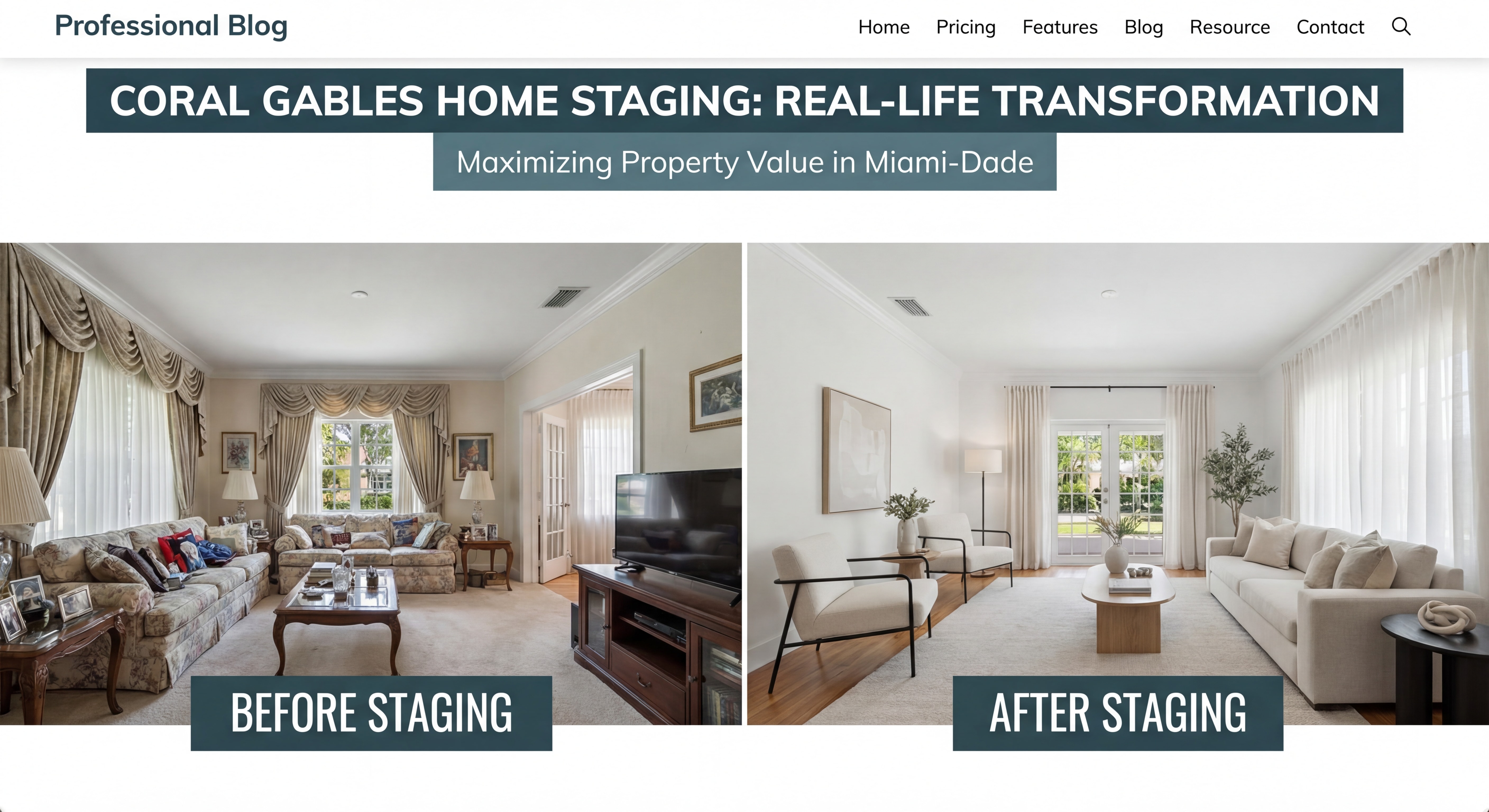
The Situation: After the passing of their mother, two adult siblings inherited a 3-bedroom, 2-bath home in Coral Gables — a property that hadn't been updated since the early 2000s. The siblings lived out of state, were unfamiliar with Florida's disclosure requirements, and disagreed on whether to renovate before selling or list as-is.
What the Agent Advised: After a thorough walkthrough and consultation with a contractor, the agent presented a clear ROI analysis:
| Update Type | Estimated Cost | Estimated Value Add | Net ROI |
|---|---|---|---|
| Full kitchen renovation | $35,000 | $28,000 | Negative |
| Fresh paint + landscaping | $4,500 | $14,000 | +211% |
| Bathroom refresh (cosmetic) | $3,800 | $9,000 | +137% |
| Professional staging | $2,200 | $11,000+ | +400% |
The recommendation: skip the major renovation, invest in high-ROI cosmetic improvements, and price competitively to attract buyers who would handle the deeper updates themselves.
Florida Disclosure Compliance: The agent also ensured all required Florida Seller's Disclosure forms were completed accurately — a step that protects sellers from post-closing legal liability, particularly important for inherited properties where the seller may not have lived in the home.
The Outcome: Listed at $875,000, the property received multiple showings in the first week and went under contract at $868,000 — just 19 days after listing. The siblings netted significantly more than they would have by sinking $35,000–$50,000 into renovations with diminishing returns.
The Lesson: For inherited properties, the instinct to "fix everything first" often backfires. A skilled listing agent Broward or Miami-Dade sellers trust will run the numbers before recommending any improvement — and will navigate the legal and disclosure landscape on your behalf.
Case Study 3: The Pembroke Pines Family Home Competing in a Hot Market
The Situation: A couple in Pembroke Pines was relocating to North Carolina for work and needed to sell their 4-bedroom home quickly. Broward County — and Coral Springs in particular — had been named a hot market in early 2026, but Pembroke Pines had slightly more inventory. They had 60 days before the husband's new job started.
The Strategy — Speed Without Sacrifice:
The agent deployed a pre-market strategy that created urgency before the home ever officially hit the MLS:
- Coming Soon campaign — The property was marketed via email to a curated list of active buyers and buyer's agents for 10 days before going live on MLS
- Open house blitz — Two back-to-back weekend open houses were scheduled for the first weekend of active listing
- Competitive pricing at market — Rather than pricing slightly above to "leave room to negotiate," the home was priced at $524,900 — exactly at market — to generate multiple-offer competition
- Offer deadline — Buyers were informed that all offers would be reviewed on a specific date, creating structured urgency
The Outcome: 47 showings in 6 days. Seven offers received. The home sold for $541,000 — $16,100 over asking price — with a 30-day close that fit perfectly within the couple's relocation timeline.
The Lesson: When you need to sell home Broward County fast, the answer isn't to drop the price — it's to build strategic demand. A pre-market campaign, competitive pricing, and an offer deadline can create a mini-auction environment that drives prices up, not down.
📊 Growing momentum in early 2026 with Coral Springs named a "hot market" – Broward County Home Sales
Case Study 4: Fort Lauderdale Investor Exits a Rental Portfolio
The Situation: An investor owned three single-family rental properties in Fort Lauderdale, all purchased between 2015 and 2018. With property taxes rising and the management burden increasing, he decided to exit the market. His challenge: two of the properties had tenants with leases expiring at different times, and he wanted to maximize value on all three without a long, drawn-out process.
The Multi-Property Strategy:
The agent recommended a sequenced approach rather than listing all three simultaneously:
- Property 1 (tenant-occupied, lease expiring in 30 days): Listed as an investment property with existing rental income highlighted in the marketing — targeting other investors. Sold to a cash buyer in 22 days at $387,000.
- Property 2 (vacant): Staged, photographed, and listed for owner-occupant buyers. Received financing offers and sold at $412,000 — $25,000 more than the investor-targeted approach would have yielded.
- Property 3 (tenant with 4 months remaining): The agent negotiated a cash-for-keys agreement with the tenant, allowing the property to be vacated early, staged, and listed for retail buyers. Sold at $398,000.
Total Portfolio Exit: $1,197,000 across three properties, with the entire process completed in under 5 months.
The Lesson: Investor property exits require a different playbook than primary residence sales. Understanding how to position each property — whether to target investors or owner-occupants — can add tens of thousands of dollars per transaction. A Fort Lauderdale real estate agent with investor experience makes this distinction automatically.
Case Study 5: Luxury Waterfront in Miami Beach — When Patience and Precision Pay Off
The Situation: The owners of a $3.2 million waterfront property on Miami Beach had previously worked with two agents who produced beautiful brochures but no offers over 8 months. When they engaged a new agent, the property had accumulated significant "days on market" — a red flag for luxury buyers who often perceive long-listed properties as having hidden problems.
The Reset Strategy:
The agent's first move was counterintuitive: take the property off the market entirely for 45 days before relaunching. During that time:
- The listing was completely rebuilt with new photography, drone footage, and a cinematic video tour
- A private preview event was hosted for top luxury buyer's agents in South Florida and select international brokers
- The property was submitted to luxury real estate networks with international reach, targeting buyers from Latin America and Europe — a key demographic for Miami Beach property sales
- The price was recalibrated from $3.2M to $2.975M based on updated comps, including recent sales data showing that Realtor.com reported South Florida million-dollar sales at record highs but with more selective buyer behavior at the $3M+ tier
The Outcome: The relaunched listing generated serious interest within 3 weeks. The property sold at $2.91 million — below the original ask, but $910,000 more than the sellers would have netted if they'd continued reducing the price on the stale listing. The deal closed in 45 days from relaunch.
The Lesson: In the luxury segment, perception is everything. A stale listing is a damaged listing. Sometimes the boldest move a Miami realtor for sellers can make is to pause, rebuild the narrative, and relaunch with precision rather than continue a losing strategy.
📊 Million-dollar home sales at all-time high in 2026, led by Miami-Dade – South Florida Luxury Market

The Pattern Behind Every Success Story
Across all five scenarios — the stale condo, the inherited estate, the relocation sale, the investor exit, and the luxury reset — the same core elements appear in every success:
| Success Factor | What It Looks Like in Practice |
|---|---|
| Accurate Pricing | CMA-driven, not emotion-driven. Priced to attract, not to anchor. |
| Professional Presentation | Staging, photography, video, virtual tours — no exceptions. |
| Strategic Marketing | MLS + digital ads + agent networks + pre-market campaigns. |
| Agent Expertise | Local knowledge of Miami-Dade and Broward micro-markets. |
| Seller Flexibility | Willingness to adjust based on market feedback. |
| Legal Compliance | Florida disclosure requirements met from day one. |
None of these elements alone guarantees a successful sale. Together, they consistently produce results that exceed seller expectations — regardless of property type, price point, or situation.
Common Seller Mistakes These Stories Reveal
The flip side of each success story is a cautionary tale. Across Miami-Dade and Broward County, the most common seller mistakes in 2026 include:
- Emotional pricing — Setting a price based on what you need, not what the market supports
- DIY photography — Smartphone photos cost sellers an estimated 5–10% in final sale price
- Ignoring staging — Buyers can't visualize potential; they buy what they see
- Choosing the wrong agent — An agent without hyper-local expertise in your specific neighborhood is flying blind
- Inflexible showing availability — Every missed showing is a missed offer
- Skipping disclosure requirements — Florida has strict seller disclosure laws; non-compliance creates post-closing liability
- Refusing to reset — Sellers who stay on a failing strategy lose far more than those who pivot early
Chiffres Clés
📊 All-Time High — South Florida million-dollar home sales reached a record in early 2026, with Miami-Dade leading luxury transactions (Realtor.com, March 2026)
💡 19 Days — Average time to contract for well-priced, professionally marketed properties in Broward County's hot sub-markets in early 2026 (CoralSpringsFlNews, January 2026)
🏠 $49M — A recent Miami-Dade commercial property sold for $49 million, reflecting continued strong institutional demand for South Florida real estate (Commercial Observer, March 2026)
📈 February 2026 — South Florida home sales grew month-over-month, with Broward and Palm Beach counties outperforming Miami-Dade in volume (The Business Journals, March 2026)
Questions Fréquentes (FAQ)
How long does it take to sell a house in Miami-Dade or Broward County in 2026?
It depends heavily on pricing and presentation. Well-priced, professionally marketed homes in Broward County's hot markets like Coral Springs are going under contract in as few as 11–19 days. In Miami-Dade, the condo market is more competitive, with correctly priced units taking 3–6 weeks on average. Overpriced or poorly presented properties can sit for 90+ days, accumulating stigma that further depresses final sale prices.
Do I need a real estate agent to sell my house in Florida?
Florida law does not require you to use a real estate agent, but the data consistently shows that professionally represented sellers net significantly more than FSBO (For Sale By Owner) sellers — typically 6–13% more, even after commission costs. In a nuanced market like South Florida, where buyer demographics, neighborhood dynamics, and disclosure requirements vary significantly, professional representation is a major financial advantage.
What is the best time to sell a home in South Florida in 2026?
South Florida's selling season is somewhat inverted compared to the national norm. The strongest buyer activity typically occurs from January through April, when northern buyers are visiting and snowbirds are in residence. However, 2026 data shows consistent year-round demand, particularly at the luxury end. The "best time" is ultimately when your property is fully prepared and priced correctly — not a specific month.
How much does it cost to sell a house in Miami-Dade County?
Typical seller costs in Florida include: real estate commission (negotiable, typically 5–6% of sale price), title insurance (in Miami-Dade, often the seller's responsibility, approximately 0.5% of sale price), documentary stamp taxes ($0.70 per $100 of sale price), any agreed-upon repairs or closing cost credits, and prorated property taxes. On a $600,000 home, total seller costs typically range from $38,000 to $48,000 before net proceeds.
How do I sell an inherited property in Miami or Broward County?
Inherited property sales in Florida involve several specific steps: confirming legal ownership through probate (if applicable), completing Florida's required Seller's Disclosure even if you never lived in the home, evaluating whether to sell as-is or make targeted improvements, and pricing based on current market comps rather than emotional attachment. Working with a real estate agent experienced in estate sales is strongly recommended — the process has legal, tax, and practical dimensions that require specialist knowledge.
Conclusion: Your Success Story Starts With the Right Strategy
The sellers in these stories — the Aventura condo owner who broke a 90-day stalemate, the out-of-state siblings who cleared an inherited estate in 19 days, the Pembroke Pines couple who sold $16,000 over asking — didn't achieve these results by accident. They achieved them by combining accurate market intelligence, professional presentation, and expert representation in one of the most competitive real estate environments in the country.
Whether you're selling a primary residence in Kendall, a luxury waterfront in Miami Beach, a rental property in Fort Lauderdale, or an inherited home in Coral Gables, the principles are the same. The market rewards preparation, penalizes emotion, and consistently favors sellers who treat their property as an asset to be strategically positioned — not just a home to be listed.
Ready to write your own success story? Contact us today for a complimentary, no-obligation market analysis of your Miami-Dade or Broward County property. We'll walk you through current market conditions specific to your neighborhood, a realistic pricing strategy, and a customized marketing plan designed to maximize your net proceeds.
Let's create a selling strategy built around your goals, your timeline, and your property — and get you to the closing table with confidence.


