
What does it actually look like when a luxury real estate market fires on all cylinders? Not in press releases or projections — but in real deals, real buyers, and real results? In Miami's new construction luxury market in 2026, the answer is playing out in extraordinary fashion: a single condo tower crossing $1.2 billion in pre-construction sales, a spec home on the Venetian Islands asking $59.9 million, and four of the world's five wealthiest people quietly closing on waterfront estates within miles of each other.
These are not outliers. They are the documented, verifiable proof points of a market that has undergone a structural transformation. New construction luxury homes in Miami are no longer simply aspirational — they are among the most strategically coveted real estate assets on the planet. This article tells that story through the people, projects, and decisions that lived it.
Table of Contents
- The Numbers That Changed Everything
- Case Study 1: The Mandarin Oriental — When Scarcity Meets Demand
- Case Study 2: The Billionaire Migration to Miami Waterfront Properties
- Case Study 3: Latin American Investors Turn Brickell Luxury Condos Into Cash-Flowing Portfolios
- Case Study 4: "Forte" — The Venetian Islands Spec Home That Rewrote the Blueprint
- Case Study 5: The Broker Who Closed $1 Billion in a Single Year
- What These Stories Tell Buyers in 2026
- Key Statistics
- FAQ
The Numbers That Changed Everything
Before diving into the individual stories, the macro context matters. In January 2026, Miami overtook New York City as the major U.S. city with the most $1 million-plus homes — a milestone that would have seemed impossible a decade ago, according to Realtor.com's Luxury Housing Report. The city now counts over 10,591 million-dollar-plus listings.
"Miami overtakes New York as the major U.S. city with the most $1 million homes as wealthy buyers head South"
— Realtor.com
Meanwhile, a New York Times investigation published in March 2026, titled "The New Miami Gold Rush," documented how the city has evolved from a seasonal playground into a permanent global capital for ultra-high-net-worth individuals. Mortgage rates, which dropped from roughly 7% in early 2025 to 6.18% by year-end, have reignited buyer momentum across South Florida heading into 2026 — particularly in the luxury condos Miami new construction segment.
📊 Record annual median price of $1,030/sq ft in 2025, up 4.5% YoY – Miami luxury condo market
The stage is set. Now, the stories.
Case Study 1: The Mandarin Oriental — When Scarcity Meets Demand
The Project: The Residences at Mandarin Oriental, Miami
Developer: Swire Properties
Location: Brickell Key (private island)
Milestone: $1.2 billion+ in pre-construction sales for the South Tower alone
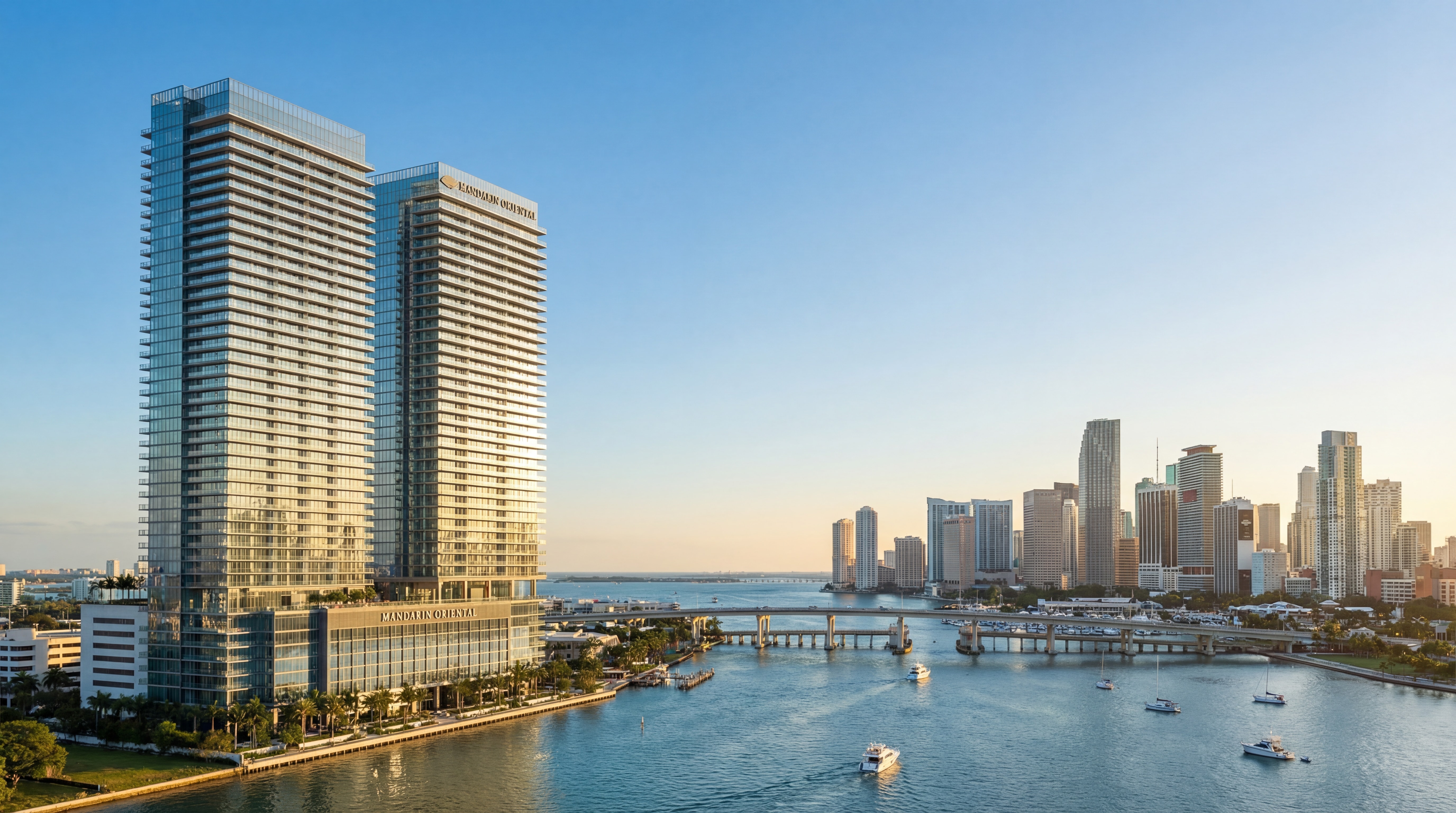
Few stories in Miami luxury real estate 2026 are as compelling as the Mandarin Oriental Residences. When Swire Properties launched sales for the South Tower in April 2024, the market response was immediate and historic. The project crossed the $1 billion sales threshold while still only 50% sold — recording a staggering $127 million in a single month at peak velocity. By November 2025, Swire launched the North Tower, where hotel residences were already 75% reserved before the official sales launch.
What drove this extraordinary demand? Three converging factors:
- Irreplaceable geography. Brickell Key is a private 44-acre island in Biscayne Bay. The Mandarin Oriental sits on the last developable parcel — meaning no competing development can ever replicate the view corridors or the exclusivity.
- World-class design pedigree. Architecture by Kohn Pedersen Fox (KPF) and interiors curated by Parisian designer Tristan Auer created a product with genuine global appeal.
- Branded hospitality. The integration of Mandarin Oriental's five-star service infrastructure — spanning 100,000 square feet of amenities — gave buyers the lifestyle certainty that pure residential projects cannot offer.
| Feature | The Residences at Mandarin Oriental |
|---|---|
| Location | Brickell Key private island |
| Architect | Kohn Pedersen Fox (KPF) |
| Interior Design | Tristan Auer (Paris) |
| Total Amenity Space | 100,000 sq ft |
| Sales Milestone | $1.2B+ (South Tower alone) |
| Starting Price | From $4.9M |
| Anticipated Completion | 2030 |
The lesson for buyers: pre-construction in irreplaceable locations remains the highest-leverage entry point in Miami's luxury market. Pricing at launch typically represents a meaningful discount to delivery pricing — and in a market with structural supply constraints, that discount has historically been substantial.
📊 25–40% appreciation in recent development cycles – Pre-construction luxury condos in Miami
Case Study 2: The Billionaire Migration to Miami Waterfront Properties
The Buyers: Mark Zuckerberg, Sergey Brin, Larry Page, Jeff Bezos
The Market: Miami waterfront properties, Indian Creek Island, Coconut Grove, Allison Island
The Signal: Four of the world's five wealthiest people now own waterfront estates in the Miami area
If you needed a single data point to validate Miami's transformation into a global wealth capital, this is it.
In early March 2026, Meta CEO Mark Zuckerberg closed on a waterfront estate at Indian Creek Island for $170 million — setting the all-time record for the most expensive home ever sold in Miami-Dade County history. He joins Amazon founder Jeff Bezos, who has committed over $234 million to three properties on the same exclusive man-made island, informally known as the "Billionaire Bunker."
The Google founders followed their own path. Larry Page quietly assembled approximately $188 million in waterfront estates in Coconut Grove, including the landmark Banyan Ridge compound — a 4.5-acre property that traded at $101.5 million. Meanwhile, Sergey Brin closed on a $51 million waterfront home on Allison Island in Miami Beach, purchasing the former residence of LVMH CEO Michael Burke at 6596 Allison Road.
"4 of the world's 5 richest people now have waterfront estates in the Miami area"
— Yahoo Finance / Fox Business
"What do four of the world's five richest people have in common? They all have megamillion waterfront estates in Miami and Miami Beach." — Fox Business, March 2026
What's driving this migration? The analysis from the LA Times and multiple financial publications points to a convergence of factors: California's proposed wealth tax, Florida's zero state income tax, deep-water access for yachts, and a lifestyle infrastructure — world-class dining, arts, and privacy — that rivals any city on earth.
The implications for the broader Miami luxury real estate market are profound. When the world's most financially sophisticated individuals concentrate capital in a single geography, they validate the asset class in ways no marketing campaign ever could.
Case Study 3: Latin American Investors Turn Brickell Luxury Condos Into Cash-Flowing Portfolios
The Buyers: Colombian, Mexican, and Argentine investors
The Market: Brickell luxury condos, new construction
The Result: 52% of all new-construction sales in South Florida driven by international buyers; 86% of foreign transactions from Latin America
The billionaire migration captures headlines, but the deeper structural story of Brickell luxury condos in 2026 is being written by Latin American investors — and it's a story of disciplined, portfolio-minded buying at scale.
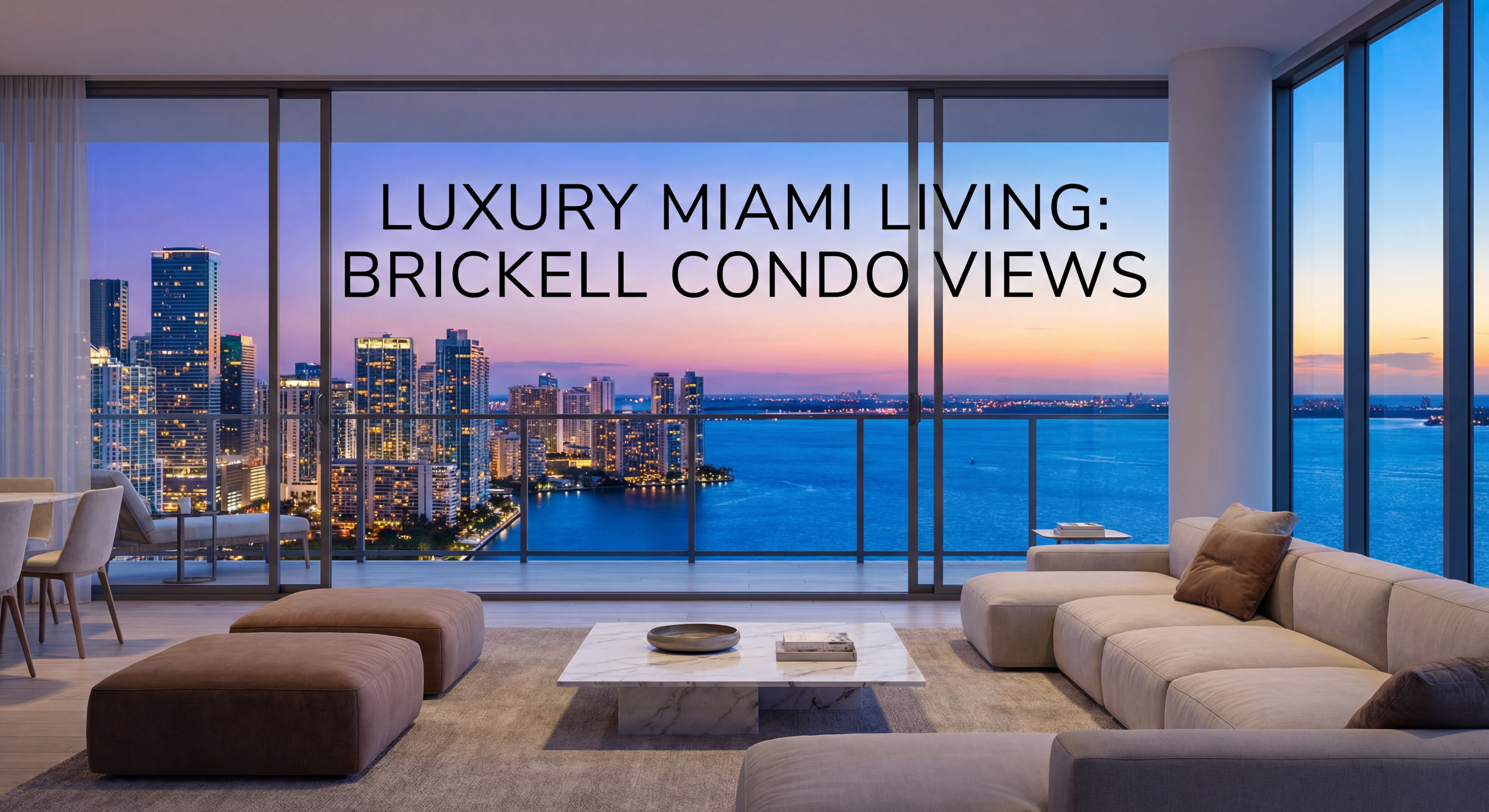
According to Capital Analytics Associates' February 2026 report, foreign buyers now account for 52% of all new-construction home sales in South Florida — a figure that would have been unthinkable in any other major U.S. market. Colombian buyers (23%) and Mexican buyers (20%) lead the charge in new-construction unit purchases. And their preferred destination? Brickell, consistently ranked as the #1 neighborhood for global investors.
The strategy is straightforward but effective:
- Buy pre-construction in well-capitalized towers (Cipriani Residences, 1428 Brickell, Baccarat Residences) at launch pricing
- Hold through construction (typically 3–4 years), during which the deposit schedule — not the full purchase price — represents the capital outlay
- Deliver into a rental market where average monthly rents in Brickell reached $7,708 in Q1 2026, generating gross yields of approximately 10.5% on purchase price
Miami Today reported in August 2025 that Latin Americans are specifically targeting new Brickell condos as rental assets, drawn by the neighborhood's live-work-play density, proximity to Miami's financial district, and the steady stream of corporate tenants — financial professionals, tech company relocators, and international executives — who demand exactly what new construction delivers: smart home technology, resort amenities, and zero deferred maintenance.
"Latin Americans scoop up new Brickell condos to make them rentals"
— Miami Today
The numbers at the project level confirm the strategy's appeal. At the time of the 2025 midyear report, Cipriani Residences Miami was 73% sold, UNA Residences had reached 97% sold, and Baccarat Residences stood at 97% sold — all testament to the depth of international demand for well-positioned luxury condos Miami new construction.
| Development | % Sold (Mid-2025) | Price/SqFt | Delivery |
|---|---|---|---|
| UNA Residences | 97% | $2,165 | Q4 2025 |
| Baccarat Residences | 97% | $1,800 | Q4 2028 |
| Cipriani Residences | 73% | $1,817 | Q1 2028 |
| The Residences at 1428 Brickell | 60% | $1,993 | Q1 2028 |
| St. Regis Residences | 75% | $2,968 | Q4 2027 |
Case Study 4: "Forte" — The Venetian Islands Spec Home That Rewrote the Blueprint
The Project: Forte at 1413 North Venetian Way, Miami Beach
Builder: Maven Construction
Ask Price: $59.9 million
What It Represents: The new standard for new construction luxury homes in Miami
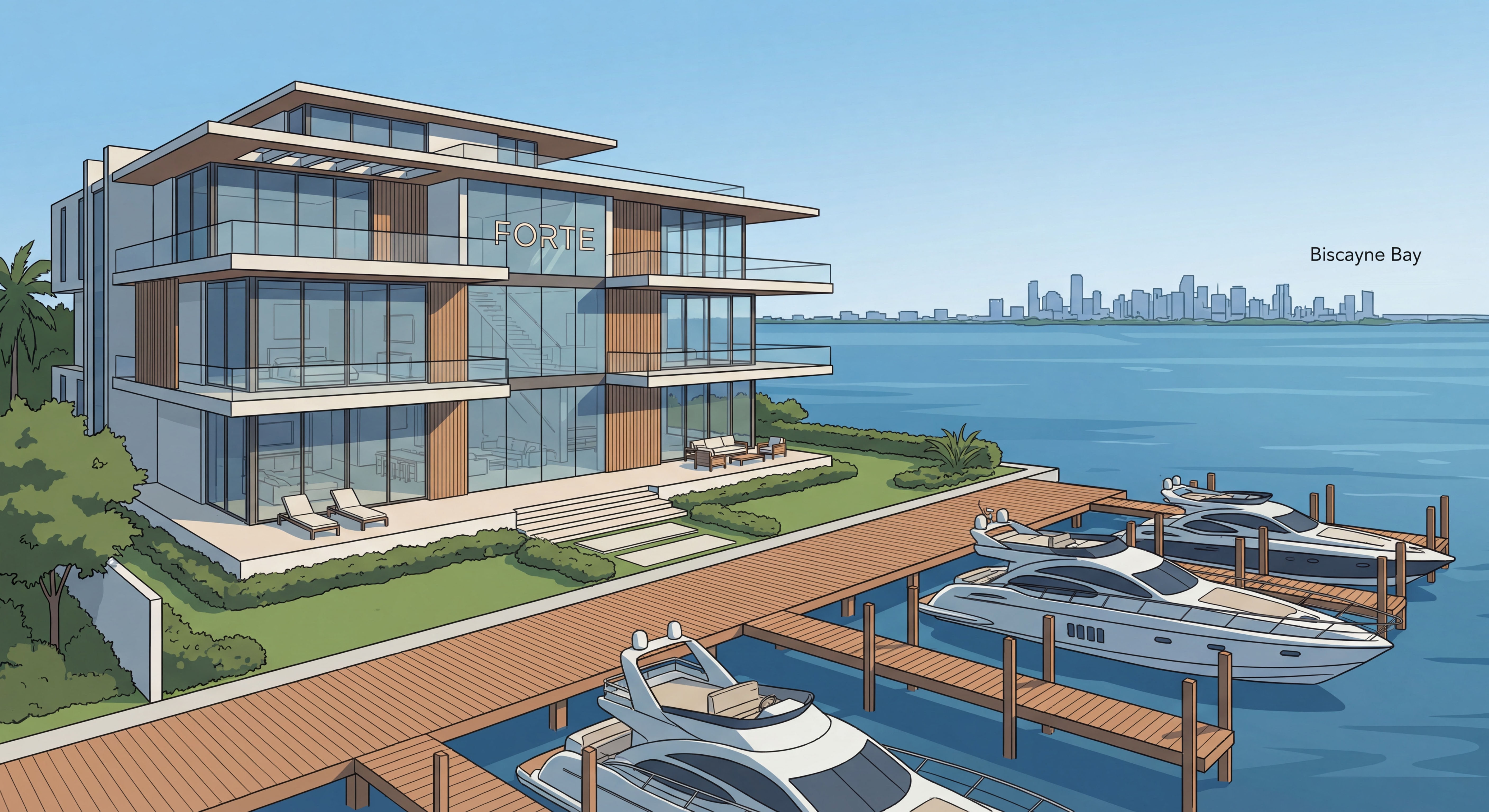
When Maven Construction's president decided to build his personal residence on the Venetian Islands — the exclusive chain of man-made islands connecting Miami and Miami Beach — he did so with a singular commitment: no compromises. The result, a modern architectural masterpiece called Forte, debuted in January 2026 asking $59.9 million and immediately became one of the most discussed new construction properties in South Florida.
The numbers tell part of the story: 10,689 square feet of living space on a 13,188-square-foot lot, 7 bedrooms, 7.5 bathrooms, 105 feet of deep-water dockage, and a subterranean garage for 8–10 vehicles. But the true differentiator is the execution philosophy.
Designed through a collaboration between Varabyeu Partners, Javier Robles Studio, and Artefacto, Forte integrates:
- Full-height glass walls creating seamless indoor-outdoor flow
- 360-degree rooftop terrace with panoramic views spanning downtown Miami to the open bay
- Crestron smart-home automation throughout every system
- Dual kitchens, private theater, and Brazilian custom closets
- Elevated 14 feet above sea level — a critical resilience feature for waterfront properties in South Florida
"Newly completed waterfront spec home on Miami Beach's Venetian Islands asks $59.9 million"
— PROFILEmiami / Robb Report
What Forte demonstrates for the broader market is significant: the spec home category in Miami has evolved from opportunistic construction to curated, brand-quality product. Builders are now competing on design pedigree, technology integration, and lifestyle completeness — not just square footage and location. For buyers who want the immediacy of a move-in-ready waterfront home without the 3–5 year pre-construction wait, this segment represents a compelling alternative.
The Venetian Islands context matters too. As Robb Report noted, the enclave has become a "regular haunt for high-end homeowners," with multiple trophy properties trading at $33 million to $65 million in recent years — establishing a price corridor that Forte's ask comfortably inhabits.
Case Study 5: The Broker Who Closed $1 Billion in a Single Year
The Story: Maile Aguila, "The Condo Queen"
The Achievement: $1 billion+ in Miami condo sales in a single year
The Market: New construction luxury condos, Brickell and beyond
No examination of Miami's luxury new construction success stories would be complete without acknowledging the human infrastructure that makes these deals happen. HousingWire's March 2026 profile of Maile Aguila — dubbed "The Condo Queen" — offers a window into what it takes to operate at the apex of this market.
The daughter of 1960s Cuban exiles, Aguila spent 30 years building hyper-local expertise in Miami's condo market before closing $1 billion in sales in a single year for a multi-national developer. Her story is a masterclass in what the best luxury real estate specialists provide: not just access to listings, but deep knowledge of developer track records, construction timelines, building certifications, and the nuanced differences between projects that, on paper, appear identical.
Her insights are instructive for any buyer entering the Miami luxury real estate 2026 market:
- Know the developer's capitalization. The $565 million construction financing JLL secured for The Residences at 1428 Brickell through JP Morgan and Sculptor is the kind of institutional backing that separates serious projects from speculative ones.
- Understand what "sold" means. A tower that is 57% presold at construction financing is a fundamentally different risk profile than a project launching sales with no deposits in hand.
- Think in cycles, not moments. Miami condos have appreciated 102% over the past decade (2015–2025). The buyers who captured the most value entered early, with the right advisor, in the right buildings.
"The Condo Queen: How a Miami broker closes $1B+ a year"
— HousingWire
What These Stories Tell Buyers in 2026
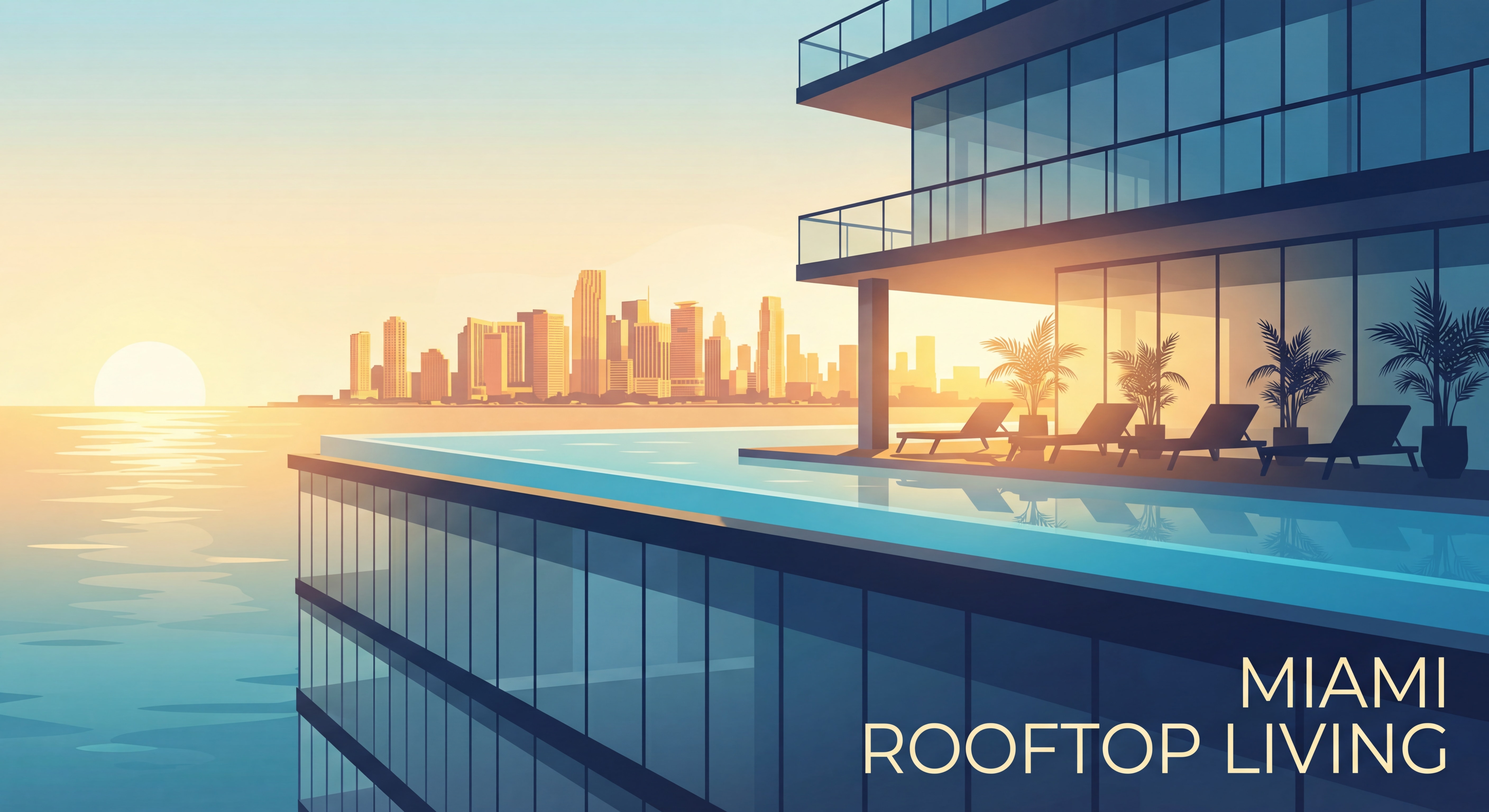
Taken together, these five case studies reveal a market operating with rare structural depth. The patterns are consistent and instructive:
1. Geography is the ultimate differentiator. Whether it's Brickell Key's last developable parcel, Indian Creek Island's billionaire enclave, or the Venetian Islands' deep-water dockage, the properties that command premiums and hold value share one characteristic: they occupy irreplaceable land.
2. Branded residences are outperforming the broader market. The Mandarin Oriental's $1.2 billion in pre-construction sales, the St. Regis Residences at 75% sold, and the Baccarat Residences at 97% sold all confirm that buyers are paying a premium for the service certainty and lifestyle infrastructure that global hospitality brands provide.
3. International capital is structural, not cyclical. With foreigners buying 52% of new-construction homes in South Florida and Latin Americans representing 86% of the international buyer pool, this demand is not a pandemic-era anomaly — it is a permanent feature of Miami's real estate ecosystem.
4. Pre-construction remains the highest-leverage entry point. For buyers willing to commit capital 3–5 years before delivery, Miami's pre-construction market has historically delivered 25–40% appreciation from contract to closing. The key is developer selection, project capitalization, and neighborhood fundamentals.
5. The window is open — but it narrows. Miami's luxury market has crossed a threshold. The city now has more $1 million-plus listings than New York. The world's wealthiest individuals are here. New construction luxury condos in Brickell, Miami Beach, Edgewater, and Coconut Grove are selling out before foundations are poured. The buyers who move with intention and expertise today are writing the next chapter of success stories.
Ready to be part of Miami's next luxury success story? Schedule a private consultation with our luxury real estate specialists, explore our curated collection of new construction properties, or download our exclusive Miami Luxury Market Report to begin your journey.
Chiffres Clés
📊 $1.2B+ in pre-construction sales achieved by The Residences at Mandarin Oriental Miami South Tower alone — at just 50% sold (Fortune Development Sales / CoStar, 2025)
🏙️ 10,591 million-dollar-plus listings in Miami — surpassing New York City for the first time (Realtor.com Luxury Housing Report, January 2026)
🌎 52% of all new-construction home sales in South Florida purchased by international buyers, with Latin Americans representing 86% of that pool (Capital Analytics Associates, February 2026)
💰 $221M+ combined: Mark Zuckerberg ($170M, Indian Creek) and Sergey Brin ($51M, Allison Island) closed on Miami waterfront estates in early 2026 alone (Fox Business / The Real Deal, March 2026)
📊 $342,600 gain on a Miami condo purchased in Q4 2009 and sold in Q4 2024 vs. $252,000 U.S. average – Miami home equity gains
FAQ
Is Miami's luxury new construction market still a good investment in 2026?
Yes — with important nuance. The data shows that well-positioned luxury new construction in neighborhoods like Brickell, Miami Beach, Edgewater, and Coconut Grove continues to appreciate at 3–5% annually, with pre-construction buyers historically capturing 25–40% gains from contract to delivery. The key differentiators are developer capitalization, building location, and HOA/reserve fund health. The overall condo market has more inventory than in 2022–2023, giving buyers more negotiating leverage — but the top-tier new construction projects in irreplaceable locations remain highly competitive.
Why are so many ultra-wealthy buyers choosing Miami waterfront properties over other U.S. cities?
The convergence is unique: Florida has no state income tax (saving high earners millions annually), Miami offers deep-water access for large yachts, the climate enables year-round outdoor living, and the city has evolved into a genuine global hub for finance, technology, and culture. The billionaire migration — Zuckerberg, Brin, Page, Bezos, Thiel — validates what financial analysis suggests: Miami waterfront real estate offers a rare combination of lifestyle and wealth-preservation attributes that no other U.S. market replicates at this scale.
What should I look for when evaluating new construction luxury condos in Brickell?
Focus on five factors: (1) Developer track record — have they delivered comparable projects on time and on budget? (2) Construction financing — institutional lenders like JP Morgan (as in 1428 Brickell's $565M loan) signal serious, well-capitalized projects. (3) Presale percentage — projects that are 60–75%+ sold before breaking ground carry significantly less delivery risk. (4) HOA structure and reserve funding — post-2024 Florida legislation has reformed reserve requirements, so verify compliance. (5) Amenity differentiation — in a market with dozens of luxury towers, the projects with branded hospitality, wellness infrastructure, and genuine design pedigree command the strongest resale premiums.
How do Latin American buyers typically structure their Miami condo investments?
The most common strategy involves purchasing pre-construction units in well-capitalized Brickell or Edgewater towers, leveraging the staged deposit schedule (typically 10–20% at contract, with subsequent payments over construction) to manage capital outflow. Upon delivery, units are placed into the long-term rental market — where average monthly rents in Brickell reached $7,708 in Q1 2026 — generating gross yields of approximately 10.5% on purchase price. Many buyers also explore E-2 and EB-5 investor visa pathways, which Miami's real estate ecosystem is well-equipped to support.
What is the difference between a branded residence and a standard luxury condo in Miami?
Branded residences — such as the Mandarin Oriental, St. Regis, Baccarat, Cipriani, and Four Seasons projects in Miami — integrate the service infrastructure, design standards, and global brand recognition of world-class hospitality groups into the residential product. This typically means 24/7 concierge, hotel-style amenities (spas, pools, dining, housekeeping), and the assurance that the building will be maintained to an internationally recognized standard. The premium over non-branded luxury condos is real — typically 20–30% per square foot — but so is the resilience: branded residences consistently outperform the broader market in both appreciation and rental yield, as the Mandarin Oriental's $1.2 billion in pre-construction sales demonstrates.


