
You've made the decision: Miami is where you want to be. The skyline glitters, the waterfront beckons, and the new construction pipeline is delivering some of the most extraordinary residences on the planet. But between your vision and your keys lies a process that — navigated poorly — can cost you hundreds of thousands of dollars, months of frustration, or worse, the wrong property entirely.
This guide is not a dream-seller. It's a practical, actionable playbook for sophisticated buyers who want to move confidently through Miami's new construction luxury market in 2026. Whether you're eyeing a Brickell luxury condo, a Miami waterfront property, or a pre-construction opportunity in Edgewater, these strategies will protect your investment and maximize your outcome.
Table of Contents
- Step 1: Define Your Buyer Profile Before You Tour a Single Property
- Step 2: Master the Miami Luxury Neighborhood Map
- Step 3: Decode the Pre-Construction Process
- Step 4: Vet the Developer — Non-Negotiable Due Diligence
- Step 5: Understand the True Cost of Ownership
- Step 6: Negotiate Strategically and Protect Yourself Contractually
- Step 7: Financing, Closing, and What Happens Next
- Key Statistics
- FAQ
Step 1: Define Your Buyer Profile Before You Tour a Single Property
The single biggest mistake luxury buyers make is starting with properties instead of priorities. Miami's new construction market in 2026 is vast, fast-moving, and emotionally charged. Without clarity on your goals, you'll find yourself comparing incomparable things — a 74-story Brickell tower against a boutique Coconut Grove residence — and making decisions based on whoever gave the most compelling sales presentation.
Ask yourself these four questions first:
- Is this a primary residence, second home, or pure investment? Each demands a different building type, neighborhood, and contract structure.
- What is your true 5-year plan? If you might sell in three years, pre-construction appreciation potential matters more than lifestyle amenities.
- Cash or financed? In 2026, approximately 43% of all Miami-Dade luxury transactions are all-cash. If you're financing, your building eligibility narrows significantly.
- What does "luxury" mean to you? In Miami, luxury starts at $1M and runs to $59.9M — the price recently asked for a newly completed waterfront spec home on Miami Beach's Venetian Islands. Calibrate accordingly.
"Miami overtook New York as the major U.S. city with the most $1 million homes as wealthy buyers head south"
— Realtor.com
Once your profile is clear, every subsequent decision becomes a filter, not a gamble.
Step 2: Master the Miami Luxury Neighborhood Map
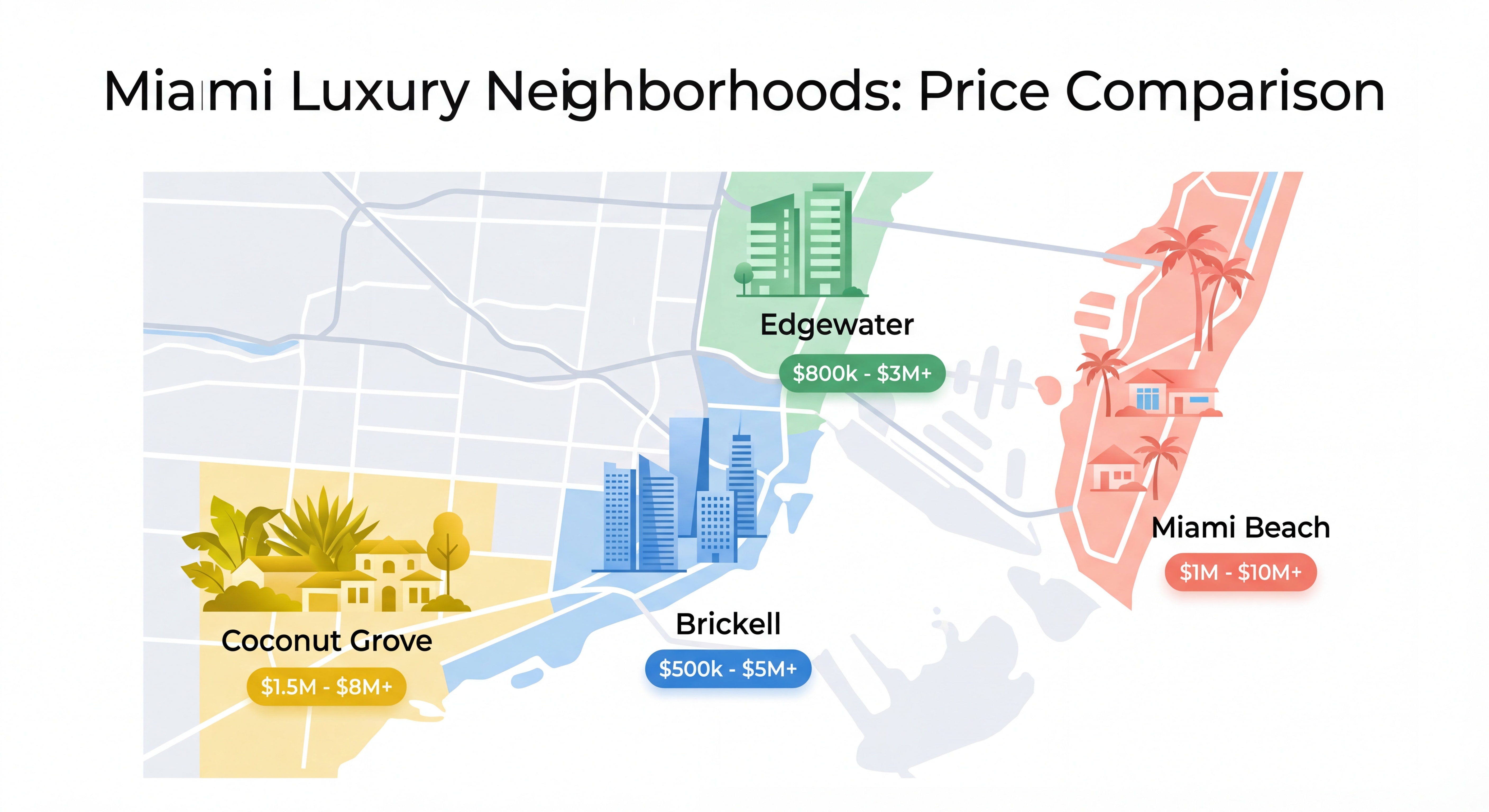
Not all luxury ZIP codes perform equally. Each Miami neighborhood has a distinct buyer profile, price-per-square-foot range, and risk-reward dynamic for new construction. Here's your neighborhood intelligence brief:
| Neighborhood | Price/SF Range | Buyer Profile | New Construction Sweet Spot |
|---|---|---|---|
| Brickell | $850 – $2,000+ | Finance execs, Latin American investors | Branded towers (St. Regis, 888 Brickell by D&G, Baccarat) |
| Miami Beach / Mid-Beach | $1,500 – $5,000+ | Oceanfront lifestyle, ultra-HNW | Cipriani Residences, Arte-tier boutique projects |
| Edgewater | $700 – $1,200 | Growth-oriented investors, younger HNW | Best appreciation upside per dollar |
| Coconut Grove | $900 – $2,500 | Families, privacy seekers | Boutique, low-density luxury |
| Wynwood / Design District | $722 – $1,021 | Creative class, short-term rental investors | Loft-style, mixed-use developments |
Pro tip: The spring 2026 launch season — described by Mansion Global as one of the biggest luxury development sales periods in recent memory — is bringing new inventory across all these corridors simultaneously. This is a buyer's window for early unit selection, but only if you've done your homework first.
"The biggest luxury developments are launching sales this spring, from Miami to London"
— Mansion Global
The International Buyer Factor
Miami is not just competing with New York or Los Angeles for luxury buyers. It is competing with London, Dubai, and Singapore. According to Capital Analytics Associates, Miami remains the #1 U.S. market for international homebuyers in 2026, with foreign nationals accounting for roughly 52% of new-construction transactions spanning 73 countries. If you're a domestic buyer, this context matters: you are competing against globally mobile capital, and the best units in the best buildings go quickly.
📊 52% of transactions – International buyer share of Miami new construction
Step 3: Decode the Pre-Construction Process
Most of Miami's premier new construction luxury homes are sold pre-construction — meaning you're buying a residence that doesn't yet exist based on floor plans, renderings, and a developer's promise. Done right, this is one of the most powerful wealth-building strategies in real estate. Done wrong, it's an expensive lesson.
Here is the exact sequence you need to understand:
The Typical Pre-Construction Timeline
1. Reservation ($25,000 – $100,000)
A soft hold on your preferred unit. Refundable at this stage in most cases. Use this window to conduct due diligence before you're contractually committed.
2. Purchase Contract Signing (10–20% of purchase price)
This is the binding moment. Your deposit is typically held in escrow. Delivery timelines in Miami luxury projects generally range from 24 to 48 months from contract signing.
3. Construction Milestone Payments (additional 10–20%)
Staged deposits tied to construction progress — foundation pour, topping off, etc. Plan your liquidity accordingly.
4. Closing (remaining balance)
The final payment, typically financed or paid in cash. This is when you receive your keys and title transfers.
Pre-Construction vs. Move-In Ready: The Strategic Comparison
| Factor | Pre-Construction | Move-In Ready |
|---|---|---|
| Pricing | Typically 10–20% below projected delivery value | Current market price |
| Unit selection | Best floors, views, and layouts available early | Limited to what's on market |
| Customization | Finish packages, upgrades available | What you see is what you get |
| Risk | Developer risk, timeline delays | Minimal — building exists |
| Appreciation | Strongest upside potential | Immediate occupancy value |
| HOA history | Unknown — first-year fees may increase | Established, auditable |
The smart move: For buyers with a 3–5 year horizon and strong liquidity, pre-construction in a well-capitalized project from a proven developer offers the most compelling risk-adjusted return in Miami's 2026 market.
Step 4: Vet the Developer — Non-Negotiable Due Diligence
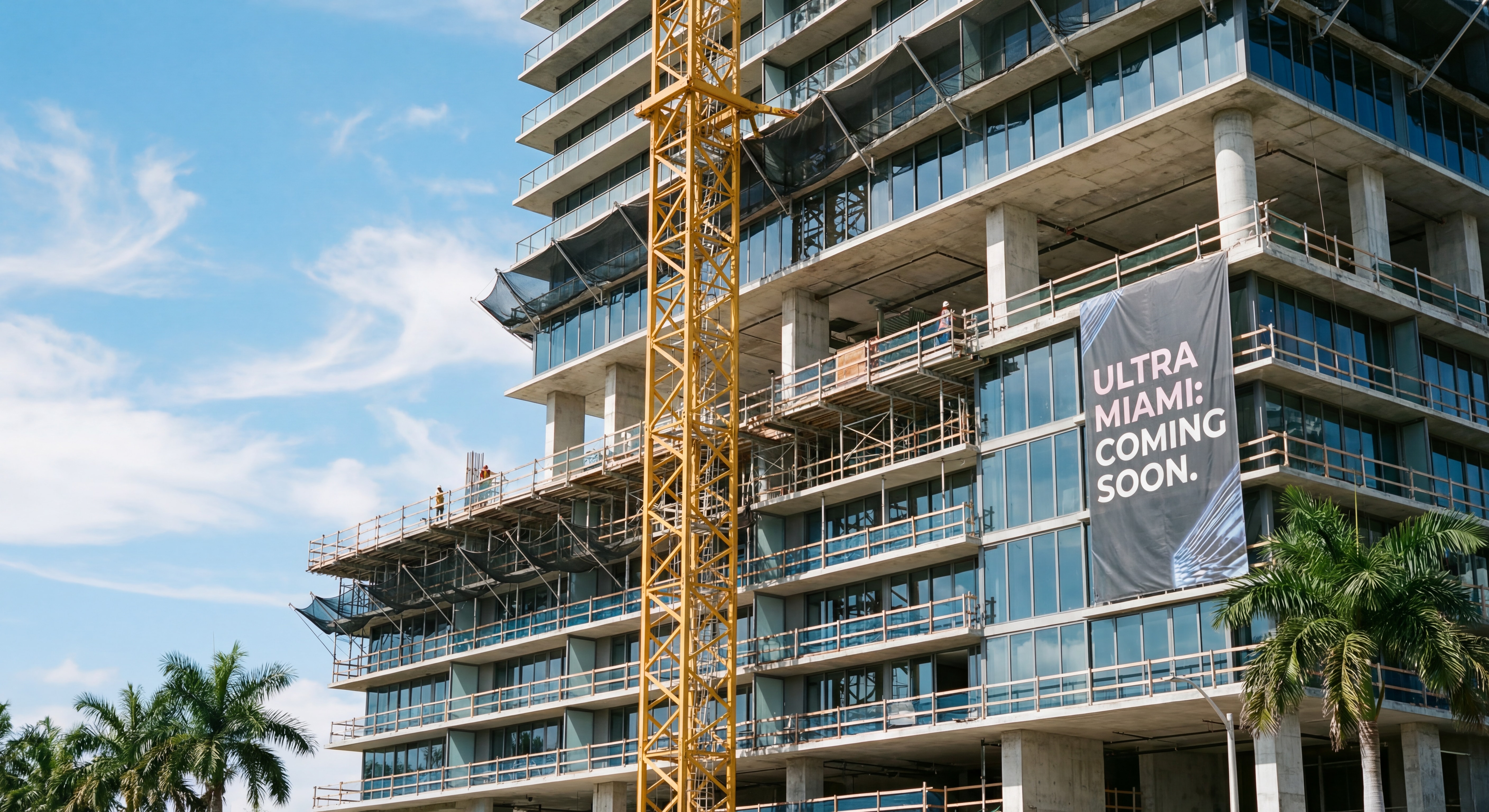
This is where most buyers skip steps — and where the most costly mistakes happen. The marketing for luxury new construction in Miami is world-class. The buildings themselves vary considerably. Here is your developer due diligence checklist:
✅ The Developer Vetting Framework
Track Record
- How many Miami high-rise projects have they delivered on time and on spec?
- Request a list of completed projects with certificate-of-occupancy dates.
- Visit completed buildings — talk to residents, not just the sales team.
Construction Financing
- Is the construction loan secured? A committed construction loan dramatically reduces the risk of project delays or cancellations.
- JLL's securing of over $565M in construction financing for a single ultra-luxury Miami tower in late 2025 is the benchmark — look for evidence of institutional backing.
"JLL secures over $565M in construction financing for ultra-luxury condominium tower in Miami"
— JLL
Presale Thresholds
- Most lenders require 50–70% of units to be under contract before releasing construction funds. Ask where the project stands.
Litigation History
- Request disclosure of any pending or past litigation related to construction defects, HOA disputes, or buyer claims.
Brand Partnerships
- Branded residences (Ritz-Carlton, St. Regis, Waldorf Astoria, Baccarat, Dolce & Gabbana) carry premiums for a reason: the brand's reputation is on the line, which creates accountability. International buyers in particular trust these names and pay accordingly.
Step 5: Understand the True Cost of Ownership
Here is where many luxury buyers get surprised — and not pleasantly. The purchase price is only the beginning. In 2026, Florida's post-Surfside condo safety laws (SB 154) have fundamentally changed the financial calculus of condo ownership.
What Florida's New Condo Laws Mean for Buyers
After the Surfside tragedy, Florida mandated:
- Milestone structural inspections for buildings 30+ years old (25+ near the coast)
- Structural Integrity Reserve Studies (SIRS) — associations can no longer waive reserves for structural components
- Boards must fund real maintenance plans with real money
The result: Older buildings are seeing HOA fee increases of $200–$1,000/month per unit, and special assessments ranging from $50,000 to $200,000+ per unit are being levied in some cases.
For new construction buyers, this is actually a competitive advantage. A brand-new luxury tower starts with a clean structural slate, modern systems, and a funded reserve study from day one. You're not inheriting decades of deferred maintenance.
The Full Cost of Ownership Breakdown
| Cost Component | Typical Range (Miami Luxury Condo) | Notes |
|---|---|---|
| HOA Fees | $1,500 – $3,500/month | Miami-Dade average exceeds $1,900/mo for high-rises |
| Property Tax | ~1.8–2% of assessed value annually | Homestead exemption available for primary residences |
| Closing Costs | 1–3% of purchase price | Higher for financed transactions |
| Flood Insurance | $200 – $400/month | Zone-dependent; essential in coastal areas |
| Special Assessments | Variable | New construction risk is minimal; older buildings carry higher exposure |
📊 Exceed $1,900/month – Average Miami-Dade luxury high-rise HOA fees
Action step: Before signing any contract, request the building's projected HOA budget, reserve study, and any disclosed special assessments. For new construction, ask what the developer guarantees for the first year of HOA fees and what happens at turnover.
Step 6: Negotiate Strategically and Protect Yourself Contractually
The word "negotiation" in Miami luxury new construction is more nuanced than in resale markets. Developers rarely discount headline prices in strong-demand projects — but they do offer value-in-kind that can represent significant savings.
What You Can Actually Negotiate
Upgrade Packages
Premium flooring, integrated smart home systems, and upgraded appliances can represent $40,000 – $75,000 in retail value. Smart buyers compare base finishes across competing buildings to understand whether "complimentary" upgrades are genuinely additive.
HOA Fee Waivers
A 12-month HOA fee waiver at $1,500–$1,900/month delivers $18,000–$22,800 in real value. This is a common developer incentive in 2026's more competitive environment.
Outside Date Protections
This is critical: your contract should specify what happens if the developer misses the delivery date. Negotiate clear remedies — the right to cancel and receive your full deposit back after a defined delay window.
Price Lock Provisions
These protect you against price increases during construction. Note: they typically do not protect against market declines, so you remain obligated to your original price regardless of market movement.
Assignment Rights
If your circumstances change before delivery, can you sell your contract? Some developers restrict this; others allow it with a fee. Know your exit options before you enter.
Your Contract Review Checklist
Before signing, have a real estate attorney experienced in Florida new construction law review:
- Deposit escrow terms and release conditions
- Developer's right to modify plans or specifications
- Delivery date and outside date remedies
- Condominium declaration and proposed budget
- HOA fee projections and first-year guarantees
- Assignment and subletting restrictions
- Force majeure clauses
Step 7: Financing, Closing, and What Happens Next
Financing Realities in 2026
The Miami Times reported in March 2026 that lower interest rates are brightening the outlook for South Florida real estate — welcome news for buyers who want to leverage their purchase rather than go all-cash.
"Lower interest rates help brighten the outlook for South Florida real estate in 2026"
— The Miami Times
Key financing considerations:
For U.S. Domestic Buyers:
- Conventional financing is available, but lenders scrutinize condo projects carefully
- Buildings must be "warrantable" under Fannie Mae/Freddie Mac guidelines — confirm this before committing
- Pre-approval should happen before you tour properties, not after you fall in love with one
- Expect 20–30% down for luxury condos
For International Buyers:
- Foreign national loan programs require 30–50% down
- Documentation: valid passport, proof of funds (last 2–3 months of bank statements), income certification, bank references from country of origin
- Currency risk is real in pre-construction — forward contracts can lock exchange rates for future milestone payments
- Ownership through an LLC is commonly recommended for estate planning and liability purposes; consult a U.S. tax attorney
The Closing Process
- Cash transactions: 20–60 days from contract to close
- Financed transactions: 45–90 days, depending on lender and building warrantability
- Closing costs: Budget 1–3% of purchase price
- Post-closing: Register for homestead exemption if primary residence (saves thousands annually on property taxes)
After You Close: Protecting Your Investment
- Property management: If renting, engage a luxury property management firm with experience in your specific building
- Rental strategy: Short-term luxury rentals in Miami generate $800–$5,000+ per night for premium units; annual gross yields range from 4–7%
- Review HOA governance: Attend your first board meeting. Understand who controls the building and how decisions are made
- Stay informed on market trends: Miami's luxury market is evolving rapidly — the New York Times called it "The New Miami Gold Rush" in March 2026 for good reason
"The New Miami Gold Rush — Miami's luxury market is drawing unprecedented global capital"
— The New York Times
Chiffres Clés
📊 52% of Miami new-construction homes are purchased by international buyers, spanning 73 countries — making Miami the #1 U.S. market for foreign real estate investment (Source: Capital Analytics Associates, 2026)
💡 $1.6 billion+ in monthly residential dollar volume in Miami-Dade in late 2025, up 11% year-over-year, with $1M+ transactions climbing nearly 20% (Source: Miami Ultra-Luxury Market Report, 2026)
🏗️ 15,000+ luxury condo units across 40+ developments are expected to deliver in Miami in 2026 — one of the largest waves of new luxury supply in the city's history (Source: Miami Waterfront Properties Market Analysis, 2026)
🔑 43% of all Miami-Dade luxury transactions are all-cash in 2026, rising significantly in the ultra-luxury segment where speed and certainty of execution are paramount (Source: Miami Association of Realtors, 2026)
Questions Fréquentes (FAQ)
What is the minimum deposit required for a pre-construction luxury condo in Miami?
Typical pre-construction deposit structures in Miami's luxury market start with a reservation fee of $25,000–$100,000, followed by a contract deposit of 10–20% of the purchase price. Additional milestone payments of 10–20% are made during construction, with the balance due at closing. Total deposits before closing typically range from 20–30% of the purchase price, though some ultra-luxury projects require more. International buyers should plan for 30–50% down if financing at closing.
How long does it take to close on a new construction luxury condo in Miami?
For pre-construction properties, the timeline from contract signing to key delivery ranges from 24 to 48 months depending on where the project is in its construction cycle when you purchase. For move-in ready new construction, cash closings can happen in 20–60 days; financed purchases typically take 45–90 days. Always confirm the developer's projected delivery date and negotiate a clear "outside date" remedy into your contract.
What are the biggest risks of buying pre-construction luxury condos in Miami in 2026?
The primary risks are: (1) developer insolvency or project cancellation — mitigated by verifying secured construction financing; (2) delivery delays — mitigated by negotiating outside date protections; (3) HOA fee increases after the first year, when developer-guaranteed rates often expire; (4) price lock provisions that don't protect against market declines; and (5) limited assignment rights if your circumstances change. Working with a specialized luxury real estate attorney and a broker with deep developer relationships significantly reduces these risks.
Do I need a real estate attorney to buy a new construction luxury condo in Miami?
Yes — absolutely. Florida new construction contracts are heavily developer-favorable by default. A real estate attorney experienced in Florida condo law can negotiate better terms around deposit protections, outside date remedies, modification rights, and HOA governance. Given that you may be committing $2M–$10M+ to a property that doesn't yet exist, attorney fees of $2,000–$5,000 represent one of the best investments in the entire transaction.
How do Florida's new condo safety laws (SB 154) affect new construction buyers?
For buyers of new construction, SB 154 is largely a competitive advantage rather than a risk. New buildings start with modern structural systems, funded reserve studies, and no legacy deferred maintenance. The laws primarily impact older buildings (30+ years, or 25+ near the coast), which face mandatory milestone inspections, Structural Integrity Reserve Studies, and potentially large special assessments. When comparing new construction to resale, this regulatory context makes new construction even more attractive from a financial risk standpoint.
Conclusion: Your Miami Luxury Investment Starts With a Plan
Miami's luxury new construction market in 2026 is extraordinary — but it rewards the prepared buyer and punishes the impulsive one. The New York Times' characterization of a "New Miami Gold Rush" is apt: gold rushes create wealth for those who arrive with the right tools, and costly lessons for those who arrive with only enthusiasm.
Your action plan is clear:
- Define your goals before you tour a single property
- Choose your neighborhood based on your profile, not the most compelling sales pitch
- Understand pre-construction mechanics — deposits, timelines, and milestone structures
- Vet every developer with the rigor of a business acquisition
- Model the true cost of ownership including HOA fees, taxes, and insurance
- Negotiate strategically — upgrades, waivers, and contractual protections
- Secure your financing before you need it
The opportunity is real. Four of the world's five richest people now own waterfront estates in the Miami area. Latin American investors are snapping up Brickell condos as long-term rental plays. Spring 2026 is seeing the biggest luxury development launch season in recent memory.
The question isn't whether Miami luxury new construction is a smart move. It's whether you're equipped to execute it well.
Schedule a consultation with a luxury new construction specialist today to access off-market inventory, developer relationships, and the insider knowledge that separates exceptional outcomes from expensive mistakes.


